Battery Energy Storage for Commercial Buildings: Benefits, Cost, and ROI
Battery Energy Storage Systems help commercial buildings manage peak demand, store renewable energy, support selected backup loads, reduce diesel dependence, and improve energy control. Their value depends on correct sizing, intelligent EMS operation, safe integration, and realistic ROI modeling based on load data, tariffs, efficiency, degradation, and future power needs.
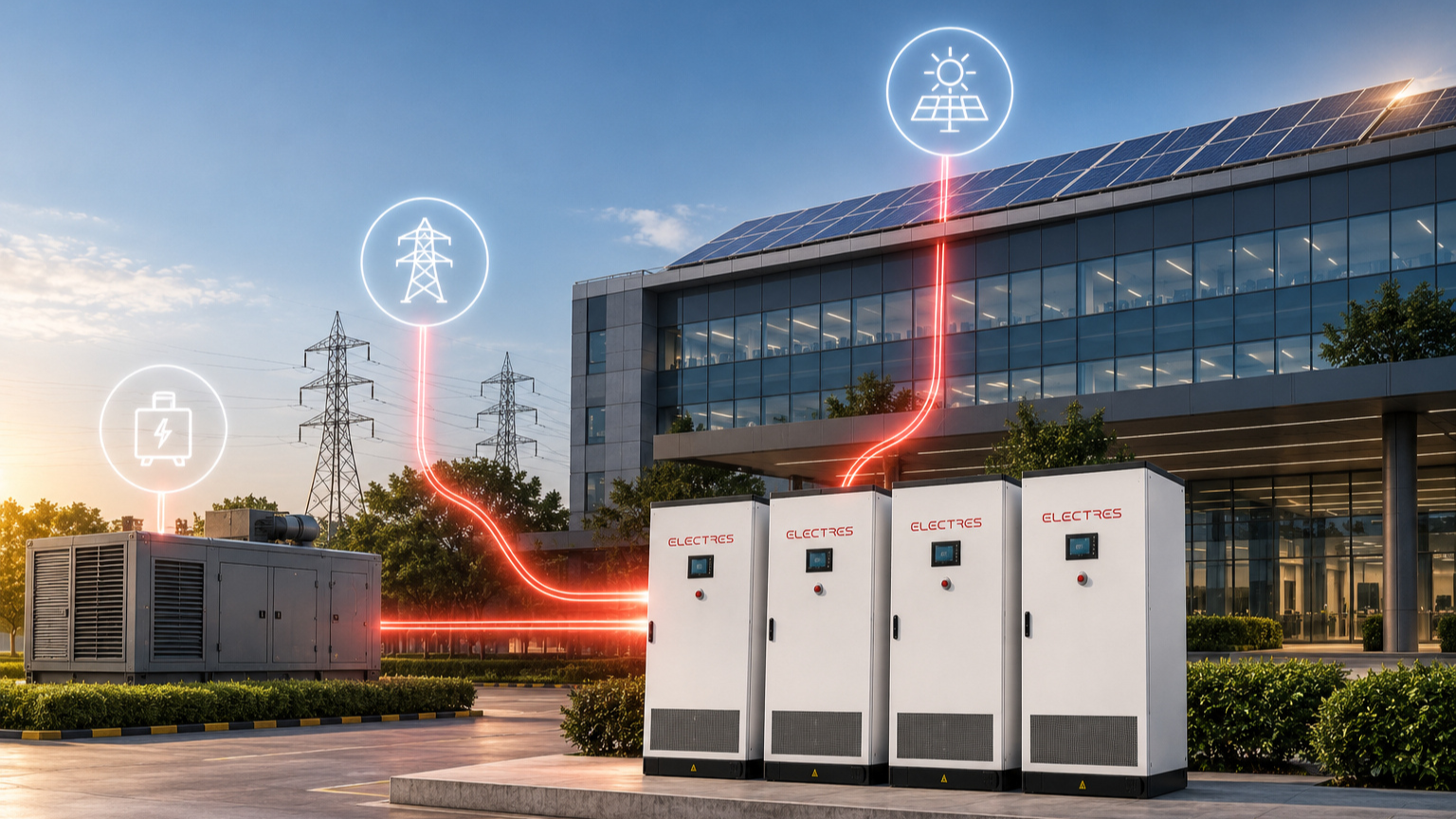
Commercial buildings today are evaluated not only by how much electricity they consume but also by how effectively they control, store, and optimise that energy. For offices, hospitals, hotels, malls, warehouses, manufacturing units, data centres, and institutional campuses, power directly affects uptime, operating cost, production continuity, occupant comfort, safety, and long-term infrastructure planning.
This is where Battery Energy Storage for Commercial Buildings becomes a strategic energy solution. A commercial Battery Energy Storage System, or BESS, does more than provide backup power. It helps a site store electricity from solar, wind, or other renewable sources, discharge it when demand rises, reduce peak load pressure, improve renewable energy utilisation, and support stable operations.
In simple terms, BESS turns electricity from a fixed utility expense into a controllable energy asset that can improve reliability, flexibility, and cost performance across commercial and industrial facilities.
The Real Problem: Commercial Buildings Do Not Just Need Power, They Need Controlled Power
Most commercial and industrial buildings already have access to grid power, solar power, diesel generators, or UPS systems. Still, many sites continue to face the same energy challenges.
Peak demand rises during production hours, HVAC loads, shift changes, machine start-up, EV charging, cooling requirements, or evening operations. Solar and wind power may be available, but demand may not always align with renewable generation. Diesel generators may provide backup power, but fuel costs, maintenance, emissions, and low-load operation can reduce efficiency.
Power availability alone does not solve these issues. The real requirement is controlled power.
Commercial buildings can use BESS to store electricity from the grid or renewable sources, release it during high-demand periods, support selected backup loads, and improve overall energy management.
When peak load, solar mismatch or backup dependency affects operations, Electres BESS helps commercial sites store, manage, and use energy more intelligently.
That is why BESS is becoming a serious part of future-ready energy infrastructure, especially for Indian commercial and industrial facilities where grid conditions, tariff structures, renewable integration, and operational continuity all matter.
What Is a Battery Energy Storage System for Commercial Buildings?
A Battery Energy Storage System is an integrated energy solution that stores electrical energy and delivers it when required. In a commercial building, it usually works with the grid, rooftop solar, diesel generators, electrical loads, and the site’s energy management system.
A typical commercial BESS includes battery modules, a Battery Management System, a Power Conversion System, an Energy Management System, protection systems, thermal management, monitoring, and control software.
The battery stores electrical energy as DC power. The Power Conversion System converts power between DC and AC so it can interact with the building’s electrical network. The Battery Management System monitors battery health, voltage, temperature, state of charge, and safety conditions. The Energy Management System decides when to charge, discharge, reserve power, or support specific loads.
For buyers, two terms are especially important: kW and kWh.
kW is power. It shows how much load the system can support at a given moment.
kWh is energy. It shows how long the system can support that load.
A 250 kW / 500 kWh system, for example, can deliver 250 kW for roughly two hours before accounting for system losses and operating reserves. This difference matters because undersizing either power or energy can reduce the system’s actual value.
Where BESS Creates the Most Value in Commercial and Industrial Buildings
The strongest value of BESS is not limited to backup. In many commercial buildings, backup is only one part of the equation. The larger value comes from energy flexibility.
1. Peak Shaving
Peak shaving reduces the highest demand drawn from the grid. During short high-load periods, the battery discharges and supports part of the site load. This helps reduce peak demand spikes and may support demand-charge savings where the applicable tariff structure includes demand-based charges.
For buildings with elevators, chillers, compressors, pumps, machinery, EV chargers, or high HVAC demand, peak shaving can become one of the most important BESS use cases.
2. Load Shifting
Load shifting means charging the battery when electricity is affordable or more available and discharging it when grid electricity is costlier, or demand is higher. This is especially relevant where Time-of-Day tariffs apply.
In simple terms, the site uses energy at the right time rather than only when the grid supplies it.
3. Better Solar Utilization
Many commercial buildings install rooftop solar but still export, curtail, or underuse part of their generation. A BESS allows excess solar energy to be stored and used later during evening loads, peak periods, or backup events.
This improves solar self-consumption and can increase the practical value of the solar plant.
4. Backup and Operational Continuity
A BESS can support critical loads during outages, short interruptions, or transition periods. It can also reduce dependence on diesel generators for every minor power disturbance.
For hospitals, cold storage, data rooms, manufacturing lines, and commercial campuses, this continuity can protect both operations and revenue.
5. Future Load Readiness
Commercial buildings are adding more electrical loads: EV charging, automation, cooling, digital infrastructure, and higher equipment density. BESS helps sites prepare for these future loads without treating every new requirement as a grid expansion problem.
Commercial Solar Battery Cost: What Actually Drives the Price?
Many buyers search for commercial solar battery cost expecting a fixed per-kWh number. In reality, the cost of commercial BESS depends on the complete system design, not just the battery pack.
The main cost drivers include battery chemistry, battery capacity, power rating, Power Conversion System size, EMS capability, enclosure type, cooling method, fire-safety design, protection equipment, cabling, civil works, installation, commissioning, monitoring, warranty, and after-sales support.
For Indian commercial buildings, the cost also depends on whether the BESS is being designed for solar storage, peak shaving, backup, diesel reduction, load shifting, or a combination of these use cases.
This is why two sites with the same battery capacity may have different project costs. A simple backup-focused system is not the same as an intelligent C&I battery energy storage system integrated with solar, grid, DG, and load-side controls.
Instead of asking only, “What is the battery cost?”, buyers should ask:
- What problem should the BESS solve?
- How many hours of backup or discharge are required?
- What peak load needs to be reduced?
- How much solar energy is currently unused?
- Which loads are critical?
- What is the tariff structure?
- What level of safety, monitoring, and lifecycle support is required?
The right cost discussion starts with the load profile, not the product catalogue.
Energy Storage ROI Calculation: What Buyers Should Actually Measure
An energy storage ROI calculation should not be based on battery price alone. A BESS is a performance asset, so its ROI depends on how often it is used, what it offsets, and how intelligently it is controlled.
A practical ROI model should include:
Annual Net Benefit = Demand charge savings + Time-of-Day savings + solar self-consumption value + avoided diesel fuel cost + reduced outage loss – O&M cost – efficiency losses – degradation allowance
Then:
Simple Payback = Total Project Cost / Annual Net Benefit
Note: This formula is for preliminary estimation only. Actual ROI depends on site-specific tariffs, load profile, battery performance, operating strategy and market conditions.
This gives a basic payback view, but serious commercial buyers should go deeper. They should also evaluate Net Present Value, Internal Rate of Return, Levelised Cost of Storage, tariff escalation, diesel price movement, round-trip efficiency, battery degradation, usable depth of discharge, and expected cycle life.
For example, if a site uses BESS only during rare outages, the ROI may depend primarily on the value of avoided downtime. If the same system is used daily for peak shaving, solar shifting, and demand management, the financial value may be much stronger.
This is why BESS sizing should not be based solely on average monthly electricity bills. It should be based on interval load data, peak-demand duration, solar generation profile, critical load requirements, and tariff behaviour.
In commercial energy storage, the best ROI usually comes from stacking multiple use cases, rather than relying on a single benefit.
Key Factors That Affect Commercial BESS ROI
| Factor | How It Impacts ROI |
|---|---|
| Peak demand | Reduces short-duration demand spikes and supports demand-related cost management |
| Solar utilisation | Stores unused solar energy for later use instead of wasting or exporting it |
| DG usage | Reduces diesel fuel dependency during short outages or transition periods |
| Tariff structure | Improves value when load shifting or Time-of-Day optimization is possible |
| Battery degradation | Affects long-term usable capacity and lifetime financial performance |
| Round-trip efficiency | Determines how much stored energy is actually available for use |
| Critical load profile | Defines how much backup value the system can deliver during interruptions |
| EMS intelligence | Controls when the battery charges, discharges, reserves energy, or supports loads |
Which Commercial Buildings Benefit Most from BESS?
BESS is useful wherever power quality, cost control, backup power, peak demand, or solar utilization matters.
Manufacturing units can use BESS to manage load peaks, protect production continuity, and reduce diesel dependence.
Warehouses and logistics hubs can use it for lighting, HVAC, automation, charging loads, and backup support.
Hotels, hospitals, and commercial offices can improve comfort, uptime, and continuity of critical loads.
Malls and retail centres can manage HVAC peaks, common-area loads, and evening demand.
Educational campuses, industrial parks, and business parks can use BESS as part of a wider energy management strategy.
Data centres, telecom facilities, and EV charging hubs can also benefit where load reliability and power availability are central to operations.
The common factor is not the building type. It is the energy problem. If the site has peak demand, solar mismatch, backup dependency, or future load expansion, BESS deserves serious evaluation.
Key Factors Before Choosing a Commercial BESS
A strong commercial BESS decision starts with technical clarity.
The first requirement is the site load profile. Buyers should analyse 15-minute or 30-minute demand data wherever possible. This shows when peaks occur, how long they last, and whether they are seasonal, operational, or equipment-driven.
Next comes sizing. The system must be sized correctly in both kW and kWh. A high-kWh system with low power output may not effectively reduce peaks. A high-kW system with low energy capacity may not support longer backup or load-shifting requirements.
C-rate, depth of discharge, round-trip efficiency, battery chemistry, cycle life, and degradation also matter. LFP batteries are commonly preferred in many stationary storage applications because of their safety profile, thermal stability, and lifecycle suitability.
The EMS is another critical factor. Without intelligent control, the battery may serve only as a store of power. With the right EMS, it becomes an energy optimization tool.
Safety must be part of the core design. Thermal management, electrical protection, fire safety planning, enclosure rating, ventilation, site-level safety design, and compliance review should be evaluated before installation.
The system should also be compatible with grid supply, solar inverter output, DG operation, building loads, and monitoring systems. Integration quality directly affects performance.
Common Mistakes That Reduce BESS ROI
The most common mistake is selecting the lowest-quoted system without understanding its lifecycle value. A lower upfront price can prove expensive if it results in poor efficiency, weak controls, a limited warranty, faster degradation, or poor after-sales support.
Another mistake is sizing BESS based on average electricity consumption. Commercial buildings do not pay based solely on averages. They are affected by peaks, operating patterns, backup events, and time-based tariffs.
Some buyers also confuse kW with kWh. Others ignore degradation, depth of discharge, auxiliary consumption, and round-trip losses. These factors directly affect usable energy and long-term ROI.
Treating BESS only as a backup product is another limitation. Backup is important, but a well-designed commercial BESS can also support peak shaving, load shifting, renewable integration, and diesel reduction.
A commercial battery system should be evaluated as energy infrastructure, not just another electrical device.
How Electres Positions BESS for Indian Commercial Energy Needs
For Indian commercial and industrial sites, BESS must be designed around real operating conditions. This includes grid variability, peak-load pressure, solar adoption, dependence on diesel backup, future electrification, and the need for reliable energy control.
Electres positions BESS as part of advanced energy systems built for performance, reliability, and future-ready energy infrastructure. The focus is not only on storing energy but also on helping commercial sites use energy more effectively.
In a commercial building, this means matching battery capacity, power rating, EMS intelligence, safety architecture, and integration design to the actual site requirements. A factory, hospital, hotel, warehouse, or commercial campus may each need a different operating logic.
Electres BESS supports this shift from simple backup to intelligent energy management. It can help commercial buildings improve renewable integration, support power stability, manage peak demand, reduce diesel dependence, and prepare for future electrical loads.
For Indian businesses, that positioning is important. Energy strategy is no longer only about installing more capacity. It is about making the available capacity work harder, smarter, and more reliably through grid, solar, DG, and load-side integration.
Conclusion
Battery Energy Storage for Commercial Buildings is becoming a practical part of modern energy planning. It helps commercial and industrial sites manage peak demand, improve solar utilization, support backup power, reduce diesel dependency, and build more resilient power infrastructure.
The real value of BESS comes from correct sizing, intelligent control, technical integration, and lifecycle-based ROI planning. Buyers should look beyond battery price and evaluate how the system will perform in daily operations, under tariff conditions, and for future load requirements.
For commercial buildings, BESS is not just backup power. It is a strategic energy asset for cost control, continuity, and future-ready power management.
FAQs
1. What is Battery Energy Storage for Commercial Buildings?
2. What is the main benefit of BESS for commercial buildings?
3. How does BESS reduce commercial electricity cost?
4. What affects commercial solar battery cost?
5. How do you calculate energy storage ROI?