How to Calculate Battery Capacity for Industrial Backup Power
Calculating battery capacity for industrial backup power requires analysing critical load, backup duration, efficiency losses, usable depth of discharge, battery aging, temperature conditions, and design margins. Accurate capacity calculation ensures reliable operations, prevents oversizing, reduces diesel dependence, supports solar integration, and helps Indian industrial facilities maintain resilient and cost-effective power backup.
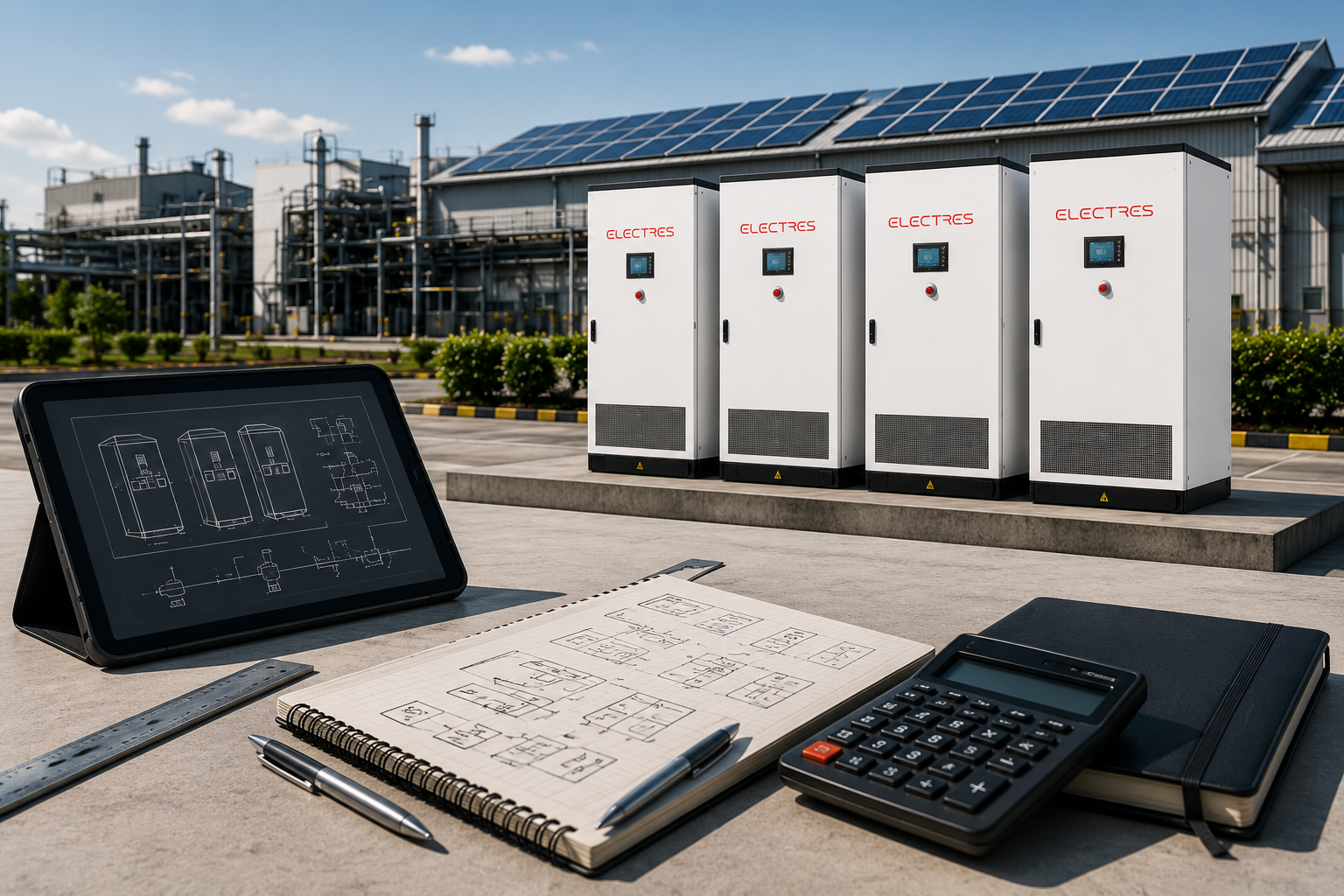
Industrial backup power sizing should never begin with a battery catalog. It should begin with the facility’s real load profile.
In Indian C&I environments, backup power is no longer just about keeping the lights on during an outage. For factories, hospitals, data centers, warehouses, hotels, and process facilities, a properly sized BESS can support critical operations, reduce dependence on diesel generators, improve solar utilization, manage peak demand, and strengthen overall power resilience.
But the wrong battery size can create expensive problems. An undersized system may fail during critical operations. An oversized system can lock unnecessary capital into unused capacity.
That is why the first question is not, “What battery capacity should we buy?” The right question is: which loads must continue, for how long, at what reliability level, and under what site conditions?
The answer to that question defines the real battery capacity.
kW vs kWh in Industrial BESS Sizing
A BESS has two ratings: kW and kWh.
The kW rating shows how much power the system can deliver at one time. It is linked to the PCS, inverter, transformer, switchgear, and discharge capability.
The kWh rating shows how long the system can support the load.
A 250 kW / 500 kWh BESS can theoretically support 250 kW for 2 hours before losses. But if the site has motors, compressors, pumps, or chillers, the PCS rating may need to be higher than the average running load.
Data Required Before Calculating Battery Capacity
Before sizing an industrial BESS, collect these inputs:
| Input | Why It Matters |
|---|---|
| Critical load in kW | Defines energy requirement |
| Load in kVA and power factor | Required for accurate PCS sizing |
| Backup duration | Defines autonomy |
| 15-minute demand data | Shows real load behavior |
| Motor starting current | Impacts PCS sizing |
| Load sequence | Avoids oversizing |
| Battery chemistry | Affects DoD, life, footprint, and safety |
| PCS efficiency | Adds conversion losses |
| Aging factor | Protects end-of-life performance |
| Temperature condition | Critical in Indian C&I sites |
| Auxiliary load | Covers HVAC, BMS, controls, and fire systems |
| Redundancy | Required for critical facilities |
Step-by-Step Battery Capacity Calculation
Let’s take a practical example of a manufacturing plant that needs backup for automation systems, control panels, lighting, IT systems, and selected process loads.
Assume the plant has a critical load of 250 kW and needs 3 hours of backup during a grid outage.
| Parameter | Assumption |
|---|---|
| Critical load | 250 kW |
| Required backup time | 3 hours |
| PCS efficiency | 95% |
| Usable depth of discharge | 80% |
| End-of-life capacity factor | 80% |
| Temperature factor | 95% |
| Design margin | 10% |
Step 1: Calculate the Energy Needed By the Load
First, calculate how much energy the load will consume during the backup period.
- Load Energy = Critical Load × Backup Time
- 250 kW × 3 hours = 750 kWh
This means the plant needs 750 kWh of usable energy delivered to the load.
However, this does not mean a 750 kWh battery is enough. In an industrial BESS, the installed battery capacity must be higher due to conversion losses, usable battery capacity limits, aging, temperature effects, and safety margins.
Step 2: Adjust For PCS Efficiency
The power conversion system is not 100% efficient. If the PCS efficiency is 95%, the battery must supply more energy than the load actually receives.
750 kWh ÷ 0.95 = 789.47 kWh
So, the battery must provide around 789 kWh before considering battery limits.
Step 3: Adjust for Usable Depth Of Discharge
A battery should not be designed to discharge 100% of its nameplate capacity. If the usable depth of discharge is 80%, only 80% of the battery capacity is considered usable.
789.47 kWh ÷ 0.80 = 986.84 kWh
At this stage, the required installed capacity increases to around 987 kWh.
Step 4: Adjust For Battery Aging
The battery must meet the required backup energy throughout its operating life, not only when it is new. The 80% Depth of Discharge factor maintains an operational reserve during normal use, while the 80% End-of-Life factor accounts separately for expected capacity degradation as the battery ages.
986.84 kWh ÷ 0.80 = 1,233.55 kWh
This means the system may require approximately 1.23 MWh to maintain the required backup performance over its lifetime. Final sizing should be validated against the battery manufacturer’s guaranteed capacity-retention and performance specifications to confirm that EOL degradation is not already included in the supplier’s usable energy rating.
Step 5: Adjust for Temperature Conditions
Battery performance can be affected by operating temperature. For sites with high ambient temperatures, additional capacity considerations may be required depending on the battery chemistry, thermal management system, and manufacturer’s specifications.
In this example, a 95% temperature factor is applied to account for potential reduction in available capacity and additional thermal management considerations:
1,233.55 kWh ÷ 0.95 = 1,298.47 kWh
The required capacity is now around 1.30 MWh. Modern LFP BESS systems with effective thermal management, such as HVAC or liquid cooling, can reduce temperature-related impacts. The actual temperature factor should be based on the manufacturer’s performance data.
Step 6: Add Design Margin
A design margin helps account for small load additions, site variation, auxiliary consumption, and operational uncertainty.
1,298.47 kWh × 1.10 = 1,428.32 kWh
So, the final recommended installed BESS capacity is approximately:
1,428 kWh, or 1.43 MWh
What this calculation actually means
The plant’s load only needs 750 kWh during the 3-hour backup window. But the installed BESS capacity must be higher because the system cannot use 100% of the battery, some energy is lost in conversion, and the battery must still perform after aging and temperature impact.
So, a 250 kW industrial load requiring 3 hours of backup may need around a 250 kW / 1.43 MWh BESS.
The final PCS rating may still need to be increased if the site has motor starting current, compressors, pumps, chillers, or other loads with high inrush current. Final sizing should always be validated with the OEM or EPC based on the actual load profile and discharge curve.
How to Convert kWh to Ah?
For industrial BESS, kWh is usually the main sizing unit. Ah is useful after the DC bus voltage is selected.
Battery Ah = Battery kWh × 1000 ÷ DC Bus Voltage
For a 1,428 kWh battery system with a 768 V DC bus:
1,428 × 1000 ÷ 768 = 1,859 Ah
The final configuration depends on cell voltage, module rating, rack design, string arrangement, BMS limits, and DC protection.
Why BESS Sizing Is Different from UPS Battery Sizing
UPS battery sizing is usually designed for instant backup and power conditioning for IT loads, PLCs, DCS, SCADA, medical equipment, and sensitive electronics.
BESS sizing is broader. A C&I BESS may support backup power, diesel reduction, solar shifting, peak shaving, load shifting, microgrid operation, and power quality improvement. That is why industrial BESS sizing should use actual demand data and site operating strategy, not only connected load.
LFP vs Lead-Acid for Industrial Backup Power
| Parameter | LFP BESS | Lead-Acid / VRLA / Tubular |
|---|---|---|
| Usable DoD | Higher | Lower |
| Cycle life | Higher | Lower |
| Maintenance | Lower | Higher |
| Footprint | Compact | Larger |
| Cycling use | Strong | Limited |
| Upfront cost | Higher | Lower |
| Best use | C&I BESS, solar hybrid, repeated cycling | Short-duration UPS or low-cycle backup |
For modern C&I BESS in India, LFP is generally preferred where the system will cycle regularly, integrate with solar, reduce DG runtime, or support peak shaving. Lead-acid, VRLA, tubular, OPzS, and OPzV batteries may still fit specific stationary backup or UPS use cases.
Common Mistakes in Industrial Battery Sizing
Common mistakes include using connected load instead of critical load, ignoring kVA and power factor, missing motor starting current, assuming 100% usable capacity, forgetting PCS losses, ignoring auxiliary load, skipping aging factor, not applying temperature derating, using monthly electricity bills instead of 15-minute demand data, and selecting battery kWh before defining the operating strategy.
When Battery Sizing Should Become a Full BESS Feasibility Study
A basic calculation is useful for estimation. A feasibility study is needed when BESS must support backup, solar shifting, DG reduction, and peak demand management together.
The study should analyze 15-minute demand data, outage history, DG running hours, diesel consumption, solar generation, tariff structure, critical load hierarchy, cycling pattern, available space, transformer capacity, switchgear readiness, safety requirements, ROI, and lifecycle cost.
Need a BESS sized for real industrial conditions? Electres BESS helps validate load profiles, backup needs, solar integration, and PCS requirements to design safer, scalable C&I energy storage systems in India.
Conclusion
Calculating battery capacity for industrial backup power is not just about multiplying the load by the backup hours. That gives the starting point. The final BESS size depends on load profile, autonomy, PCS efficiency, usable DoD, aging, temperature, C-rate, auxiliary loads, redundancy, and site operating strategy.
For Indian C&I facilities, a correctly sized BESS can reduce diesel dependency, improve resilience, support solar integration, and keep critical operations running with better control.
The right question is not, “What battery size should we buy?” It is, “What load must continue, for how long, and at what reliability level?”
FAQs
How do you calculate battery capacity for industrial backup power?
How many kWh battery is required for a 100 kW industrial load for 4 hours?
What is the difference between kW and kWh in BESS sizing?
Which battery is best for industrial backup power in India?
What factors reduce industrial battery backup time?