Peak Demand Charges Explained: Why Your HT Bill Spikes
Many HT consumers assume high electricity bills are driven mainly by total units consumed, but short demand spikes and their timing often play a bigger role. This article explains how peak demand charges work, what causes sudden load spikes in commercial and industrial facilities, and why common fixes like manual scheduling, power factor correction, or DG sets often fall short. It also shows how BESS helps control demand in real time, stabilize load profiles, and reduce HT bill fluctuations effectively for C&I operations.
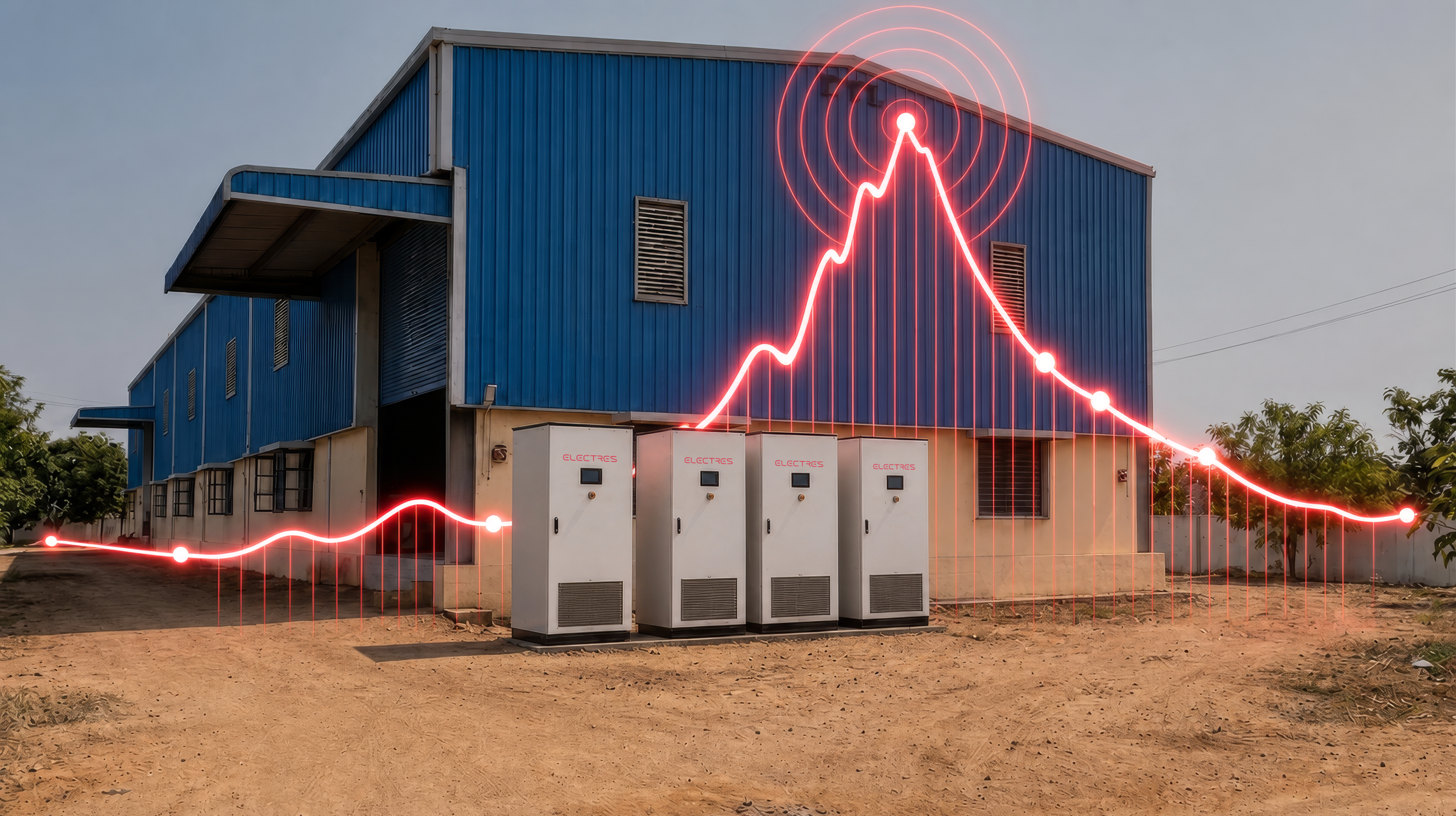
For most plant managers, the first reaction to a high electricity bill is simple. They look at units consumed. They ask practical questions.
- How many kWh did we use this month?
- Did production increase?
- Did one line run longer than usual?
- Did HVAC, cooling, or utilities consume more power?
These are sensible questions. In fact, they are the right place to start. But they do not tell the full story. An HT electricity bill is not made only from how much electricity your facility uses over a month. It is also shaped by how quickly and how heavily your operations draw power from the grid at any moment. This is the part many commercial and industrial consumers do not fully notice until their bill starts behaving in a way that does not make sense. This is why a facility can reduce its energy consumption by a noticeable margin and still see very little relief in the final bill. Sometimes the bill stays high even when production has not increased in any significant way. That confuses teams, because they assume that lower units should always mean a lower bill. But that is not always true in HT billing. The reason is simple. The part of the bill causing the impact is often not the energy charge. It is the demand charge. Maximum Demand, often called MD, is one of the most misunderstood parts of commercial and industrial electricity billing. It does not care whether your facility operated efficiently for most of the month. It does not reward you because you ran smoothly for long periods. It looks at something much stricter. It looks at the highest level of demand your meter recorded during a short time window. That means one poorly timed startup, one shift overlap, one rapid ramp-up after downtime, or one period where too many heavy loads ran together can set the demand level for the entire billing cycle. That is why an HT bill really has two stories inside it.
- The first story is about the total electricity consumed across the month.
- The second story is about your highest recorded demand window.
And for many facilities, it is the second story that is driving the spike.
What Are Peak Demand Charges?
To understand peak demand charges, it helps to think from the facility’s side for a moment.
An HT connection is not only billed based on electricity units. It is also linked to how much load your operations place on the system at any given time. For example, a facility that runs at a fairly steady load is easier to manage than one that usually runs at a moderate level but suddenly jumps to a much higher load without warning.
That is why HT consumers are not billed only for total consumption. They are also billed for demand.
Technical Definition
Peak demand charges are the charges linked to the highest average electrical demand recorded by the meter during a defined time interval in the billing cycle. In HT billing, this demand is measured over short blocks such as 15 or 30 minutes, and the highest recorded value becomes the basis for the demand-related part of the bill. This means even a brief spike in load can influence the monthly payable amount.
Energy and demand are not the same thing. Energy tells you how much electricity you used over time. This is usually measured in kWh, and in some tariff structures in kVAh. Demand tells you how heavily you draw power at a particular time. In commercial and industrial billing, demand charges are often based on kVA, though some tariffs instead use kW or sanctioned load. A simple way to understand it is this.
- Energy answers the question, “How much electricity did we use this month?”
- Demand answers the question, “What was the highest load we placed at any point?”
That difference is important. A facility can consume the same total electricity in two different months and still receive two different bills. If the same work is done in a smoother way, demand stays lower. If the same work is compressed into more intense periods, or if heavy loads overlap more often, the demand part of the bill becomes larger. For HT consumers, the meter records demand over a fixed interval. In the billing context you shared, this is treated as a short time interval sliding window. The highest average demand recorded in such a window across the month becomes the basis for the demand charge. This means the billing method does not average out your best behavior and your worst behavior and then reward you for balance. It identifies your highest demand event and applies charges based on that level. So even if your facility reached that level only once, and even if it happened for only a short time, that value can set your demand charge for the full month. This is the point many teams miss. They assume electricity cost should mainly follow units consumed. But under HT billing, cost is also shaped by intensity. The faster and more concentrated the load, the more expensive the month can become.
How Demand Charge Structures Differ Across States
The exact billing method can vary from one state to another. It depends on the DISCOM, the consumer category, the voltage level, and the tariff structure. But the principle remains the same. Demand has a real monthly cost. For example:
- MSEDCL in Maharashtra applies category-specific HT demand charges in Rs/kVA/month, while HT energy charges are billed in Rs/kVAh.
- BESCOM in Karnataka, for HT consumers, applies demand charges per kVA of billing demand and energy charges per kWh.
- PSPCL in Punjab bills energy in kVAh for many industrial categories, while fixed charges for consumers under the Contract Demand system are linked to sanctioned contract demand in kVA. Excluded smaller-load categories may instead be billed on sanctioned load in kW
These references matter because even a moderate increase in recorded maximum demand can create a noticeable rise in the monthly bill. Once an avoidable spike is considered against the applicable rate, the financial impact becomes easier to understand. At the same time, it is important to remember that tariff structures are not identical across India. Consumer sub-categories, voltage level, sanctioned demand, and the billing method can all influence the final payable amount. So the idea is common across states, but the exact impact depends on the latest tariff order of the relevant DISCOM.
Why Your Electricity Cost Changes Without Consuming More Units
This is where the confusion becomes expensive.
Imagine two facilities. Both produce the same output in a month. Both consume the same total electricity.
Facility A runs with a smoother load profile. Its machines start in sequence. Compressors do not all run together. Shift transitions are reasonably controlled. Its average load and peak load stay fairly close.
Facility B also consumes the same total units. But its operations are more clustered. Several large loads run together. Restarts after stoppages are sharper. Some heavy equipment overlaps more often. During certain periods, the facility draws much more power than usual.
Both facilities may end the month with the same kWh consumption. But Facility B will usually pay more, because its demand profile is more uneven.
That is the core of peak demand charges. They are not about total consumption. They reflect how heavily your operations draw power during certain periods.
Time Blocks and Actual Rates Also Affect Your Plant Cost
For many facilities, the billing problem is not only high demand. It is high demand during the wrong time of day.
Electricity tariffs do not treat all hours equally because system conditions are not the same all day. During some hours, power is easier and more economical to use. During others, especially in the evening peak, it becomes more expensive. That is why Time of Day pricing exists.
For an operations team, this means the cost impact of a spike depends on two things.
First, how high the spike is.
Second, when it happens.
If your facility creates a strong demand event during a higher-cost time block, the financial impact can be more severe than a similar spike at another time. This matters even more for facilities running evening shifts, late restart cycles, heat-heavy processes, or utility loads during peak operating hours.
For example, in some states, the tariff framework includes an additional charge during peak evening hours. That means power used during this block is not just costly because demand may be high. It is also priced higher under Time of Day structures.
The logic is straightforward. The idea is to discourage heavy usage during hours when overall system load is already high. So if your facility creates a strong demand event in that block, you end up paying more because your operations are drawing heavily during a constrained period.
This is why many commercial and industrial consumers feel their bill is unpredictable. From their point of view, operations may look similar, but the cost changes because the demand event happened in a more expensive time block.
What Causes Demand Spikes in Real Plants
Demand spikes usually do not look dramatic on the shop floor. They often come from everyday operations. That is exactly why they are difficult to notice. Most of the events that push MD upward are not unusual failures. They are normal facility moments that just happen to be electrically intense.
- Motor and compressor startups are one of the biggest examples. Large motors and compressors can draw much higher current during startup than during normal running. Depending on the system, this can be significantly higher than the regular running current. One machine starting may not be a major issue. But if several start close together, the demand window can rise very quickly.
- Shift changeovers are another common hidden cause. One team winds down, another starts up, support systems come online, and multiple process lines are activated in a short span. Operationally, this feels normal. Electrically, it can look like a sudden surge in load.
- Ramp-ups after downtime or power cuts are also a major trigger. When operations resume after an outage, maintenance stop, or supply interruption, there is usually pressure to recover lost output quickly. But that concentrated restart can create a short burst of power draw far above normal operations.
Then there is the overlap of heavy processes. Welding bays, furnaces, presses, chillers, compressors, and other utility-heavy systems can combine to create a sharp peak if they run together without coordination. The issue is not always one machine. Very often, it is the overlap. Seasonal loads also matter. In hotter months, cooling towers, ventilation systems, process cooling, and HVAC loads increase. These do not replace the core production load. They sit on top of it. So a facility that was comfortably within the threshold in milder weather can suddenly reach much higher peaks in summer. The practical truth is this:
- Most facilities do not have a total consumption problem.
- They have a timing problem.
- They are not necessarily using too much electricity overall.
- They are drawing too much electricity at the same time.
That is the real root of many HT bill spikes. This is also where solutions like BESS come into play. Instead of trying to manually control every load event, a well-designed system can respond in real time, supporting sudden demand and reducing the impact of these spikes. Systems like Electres BESS are designed to handle such situations, helping facilities manage load more smoothly without disrupting operations.
A Simple Plant Example
Take a facility where operations run in multiple shifts. For most of the month, activity is distributed. Different lines run at different times. Total electricity use looks balanced. On paper, everything seems under control. Now consider a situation where schedules overlap. A delayed batch, an extended shift, or a production push causes multiple lines and support systems to run together for a short period. That short overlap may be enough to push the recorded demand window much higher. Once that happens, the facility is no longer billed based on its usual operating pattern. The billing logic now reflects that concentrated period of activity. This is what makes demand charges so unforgiving. They do not consider how evenly your operations were spread across the month. They are driven by how much load came together at the same time.
Evening Peak Is More Expensive
The impact becomes clearer when you look at how demand behaves during evening operations. For many facilities, the evening period is when multiple activities come together. Production may still be running, support systems are active, and additional loads such as lighting, cooling, or utilities continue to operate. This naturally increases the overall load on the system. When a demand spike happens during this period, it is often higher than usual because several loads are already running together. This pushes the recorded demand window further up compared to a similar event at a lighter time of day. In business terms, it is not just about when electricity is used, but how much load is already active when a new demand event occurs. The more concentrated the load at that moment, the higher the impact on recorded demand.For facility teams managing second shifts, late operations, or demand-heavy evening processes, this becomes a direct cost factor. A spike during these hours is more likely to set a higher demand level for the billing cycle.
Why Usual Fixes Often Fail?
When electricity bills start becoming difficult to manage, most facilities respond with familiar solutions. Some of these are useful for other problems, but they often fail to address the real cause of MD spikes. Load scheduling and manual shutdowns sound logical at first. Shut down some non-critical equipment during high-load periods. Delay some activities. Avoid too many machines running together. But in practice, manual scheduling is hard to sustain. It depends on coordination, discipline, and consistent execution across teams. In a busy facility, operational priorities usually take over. Even when manual controls help for a while, they can create friction and affect productivity. Power factor correction is important, but it solves a different issue. Capacitor banks help with reactive power and can reduce penalties linked to poor power factor. But they do not reliably prevent real demand spikes caused by simultaneous heavy loads, startup surges, or clustered operations. Power factor correction is good practice, but it is not peak control. Diesel generators are often treated as backup support. But they are not an efficient solution for regular demand management. Fuel costs are high. Maintenance is ongoing. Running economics are weaker compared to more modern approaches. Most importantly, DG sets do not manage the load profile in a consistent and responsive way. Reducing contracted demand also sounds attractive, but it can backfire. If the facility exceeds the reduced threshold, penalties may apply, and the financial result can become worse than before. Lowering contracted demand without actually controlling the load profile is essentially a risk. The real issue is simple.
- All these approaches try to manage the bill indirectly.
- They do not actually prevent the spike before it is recorded.
So the root problem remains. The facility may improve around the edges, but the highest demand window can still rise and define the month’s cost. A more practical approach is to manage the spike at the moment it happens rather than trying to control it manually. A well-designed BESS can respond instantly to sudden load increases, reducing the impact before it reaches the meter. Solutions like Electres BESS are designed to support this, helping facilities manage demand smoothly without disrupting operations.
How BESS Helps Control Demand Charges?
Battery Energy Storage Systems address the problem in a much more direct way.Instead of reacting after a spike happens, BESS works in real time to prevent the spike from reaching the grid. This is made possible through an Energy Management System (EMS), which continuously monitors the plant’s load, tracks demand levels, and tells the battery when to charge or discharge.When the plant is operating under normal conditions or during low-demand hours, the system charges. When demand starts rising toward a defined limit, the EMS signals the battery to automatically discharge and support the load.This happens instantly and repeatedly without manual intervention. From the plant’s perspective, nothing changes. Machines continue running, production continues, and operations remain stable. From the grid’s perspective, the spike is reduced or completely avoided. The meter sees a controlled and flatter load profile.This is what makes BESS fundamentally different from diesel generators. A DG set supplies power when turned on, but it does not continuously shape your demand profile. BESS, working with an EMS, acts like a control layer on top of your electrical system. It monitors, reacts, and adjusts in real time. For peak demand charges, this difference is critical. Because the billing is based on the highest demand in a short window, the only reliable way to reduce it is to control that window. BESS does exactly that by capping how much power is drawn from the grid during peak moments. This means your demand charge is no longer set by one uncontrolled event. It is set by a controlled, predictable load level.
The Core Idea Plant Managers Should Remember
Your bill does not spike only because you used more electricity. It spikes because, for a short window, your plant demanded too much from the grid at once. That one idea changes how the problem should be managed.
- If the issue is demand intensity, the solution must control intensity.
- If the issue is the highest demand during a particular time window, the solution must protect that window.
- If the issue is random peaks, the solution must flatten the load curve before the meter records the event.
That is why BESS is not just another power asset. In this context, it is a financial control tool for HT billing.
Conclusion
Many industrial teams work hard to reduce electricity use, but still struggle to bring down the HT bill. The reason is that consumption and billing are not perfectly aligned. A plant can operate efficiently for most of the month and still see higher costs because of a short period of uncontrolled demand. That is the reality of peak demand charges. Maximum Demand charges are not a minor part of the bill. For many C&I facilities, they are one of the biggest drivers of cost variability. They reward stable, well-managed operations and increase costs when demand becomes concentrated in a short span. This is why focusing only on total units consumed often misses the real issue. A better question is not just, “How much electricity did we use?”It is also, “What did our demand profile look like during critical periods?” Once that becomes clear, the path forward becomes more practical.Manual scheduling is difficult to sustain. Capacitor banks address power factor, not demand spikes. Backup systems are designed for reliability, not continuous demand control. Reducing contracted demand without controlling load behavior introduces risk. What matters is controlling the spike before it is recorded. That is where BESS makes a measurable difference. It works directly on the load profile, responding in real time and limiting sharp demand rises before they impact billing. Instead of reacting after the fact, the system helps keep demand within a more predictable range. Electres BESS is built for real industrial conditions, helping facilities manage peak demand more effectively while bringing greater stability and control to HT electricity costs. For plant managers dealing with recurring bill spikes, this is not just a technical improvement. It is a more reliable way to operate.
FAQ
What Is Maximum Demand in Simple Terms?
Why Does My HT Bill Increase Even When Units Consumed Stay Similar?
What Causes a High Demand Spike in a Plant?
Does Power Factor Correction Reduce Maximum Demand Charges?
Can DG Sets Solve Peak Demand Charges?
How Does BESS Reduce Ht Bill Spikes?
Is BESS Only Useful for Very Large Plants?