What Is LFP Battery Technology and Why Is It Used in BESS?
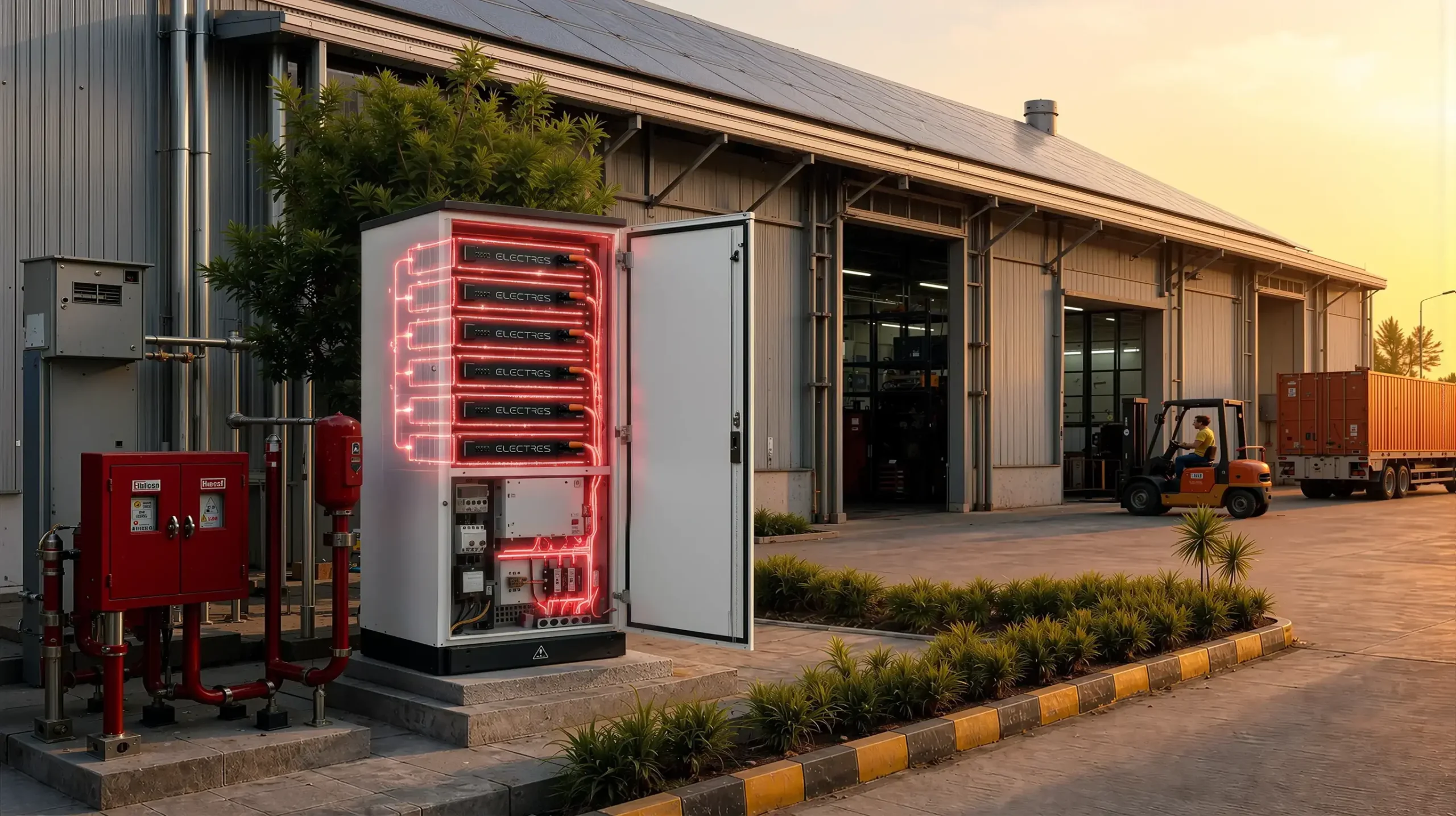
LFP battery technology has become a practical choice for modern battery energy storage systems, especially in commercial, industrial, and grid-connected projects. For C&I buyers, the focus goes beyond the meaning of LFP. What matters more is why this battery platform is preferred when safety, reliability, operating cost, warranty life, and disciplined dispatch are central to the project.
According to the IEA, battery storage was the fastest-growing commercially available energy technology in the power sector in 2023, with deployment more than doubling year-on-year. That growth is not happening because storage is a trend. It is happening because modern power systems need flexibility, integration of renewables, fast response, and better control over demand.
For C&I sites, LFP-based BESS is relevant because it supports peak shaving, solar shifting, diesel generator offset, backup power, and power-quality support with a more stable long-term operating profile.
Why Has LFP Become Widely Adopted in Stationary BESS
For stationary storage projects, battery selection is linked to lifecycle value, operational dependability, and risk control. LFP has gained widespread acceptance because it aligns with how BESS assets are actually used: repeated charging and discharging, long service life, controlled thermal behavior, and predictable output across different duty cycles.
Risk Control Over Energy Density
LFP stands for lithium iron phosphate. It uses a phosphate-based cathode system known for strong thermal and structural stability compared with many nickel-rich lithium-ion alternatives. This matters because BESS projects are not designed like EV battery packs.
EV platforms prioritize range, weight, and compact packaging. BESS projects prioritize lifecycle cost, controlled degradation, usable energy, operating safety, thermal management, and reliable dispatch.
LFP usually has lower energy density than NMC-based alternatives, but that trade-off is acceptable in containerized or cabinet-based stationary storage. In BESS, additional footprint can often be managed through site planning. Uncontrolled aging, weak warranty alignment, or unstable dispatch economics are much harder to manage after commissioning.
This is why LFP has become a preferred battery architecture for many stationary storage projects. It does not win every technical category, but it offers a strong balance between cost, safety margin, cycle life, and long-term viability.
From LFP Cell Technology to System-Level BESS Performance
The value of LFP does not stop at the cell level. In a commercial or industrial BESS, performance depends on how the cell platform is integrated into the full system. A strong cell can still underperform if the BMS, PCS, EMS, thermal management, and operating strategy are not aligned.
How BMS, PCS, and EMS Convert LFP into a Functional BESS
LFP’s technical advantage starts with its phosphate-based structure, which supports better thermal stability and a robust profile for repeated cycling. LFP has a relatively flat voltage profile over much of its operating range.
While this can provide a stable cell-voltage characteristic, it also makes accurate state-of-charge estimation more challenging. The BMS must therefore combine voltage, current integration, temperature, cell balancing, and model-based estimation rather than relying primarily on terminal voltage.
LFP has a relatively flat voltage profile over much of its operating range. While this can provide a stable cell-voltage characteristic, it also makes accurate state-of-charge estimation more challenging. The BMS must therefore combine voltage, current integration, temperature, cell balancing, and model-based estimation rather than relying primarily on terminal voltage.
However, this same flat voltage profile makes accurate state-of-charge estimation important. In a high-value BESS asset, the BMS must continuously manage cell balancing, current limits, temperature spread, SOC boundaries, SOH tracking, charge acceptance, and protection logic.
The final performance depends on the full stack: cell quality, module design, rack configuration, BMS intelligence, PCS compatibility, EMS dispatch logic, HVAC or liquid cooling, enclosure safety, auxiliary consumption, and remote monitoring.
Vulnerable controls can be underused on a strong LFP platform. A well-integrated LFP BESS, on the other hand, can convert conservative technical design into stronger lifecycle economics.
Thermal Risk and Safety Controls in LFP-Based BESS
LFP is often selected for BESS because it offers stronger thermal stability than many nickel-rich lithium-ion platforms. But for commercial and industrial projects, safer cell behavior is only one part of the safety case. The real safety outcome depends on how thermal risk, fault detection, ventilation, fire propagation, and emergency response are managed at the system and site level.
Why Safer Cell Behavior Still Needs Fire-Risk Engineering?
Compared with many nickel-rich lithium-ion platforms, LFP generally exhibits better thermal performance under elevated temperatures and abusive conditions. However, prolonged high-temperature operation still accelerates battery aging and must be controlled through appropriate cooling, monitoring, and operating limits.
LFP improves the safety profile of a BESS, but it should not be treated as a complete elimination of risk. Thermal runaway, off-gas release, fault propagation, electrical failures, ventilation constraints, deficient commissioning, and incorrect site integration can still create safety exposure if the system is not designed, installed, and monitored correctly.
A properly engineered BESS requires multiple safety layers: BMS protection, cell and module temperature monitoring, current and voltage control, gas and fire detection, enclosure design, cabinet spacing, ventilation, emergency response planning, and installation-level documentation.
The practical point is simple: LFP improves the safety base, but system engineering controls the risk size.
LFP vs NMC in Stationary Storage Procurement
The LFP vs NMC discussion is often reduced to a safety vs. energy density trade-off. For BESS buyers, that is too narrow. The better comparison is how each platform performs against the site’s duty cycle, thermal environment, warranty model, and commercial objective.
| Evaluation Area | LFP Battery Technology | NMC Battery Technology |
|---|---|---|
| Energy density | Lower, but acceptable for most stationary BESS layouts | Higher, useful where the footprint is highly restricted |
| Thermal behavior | Generally stronger thermal stability | Requires tighter thermal and safety management |
| Cycle-life fit | Strong fit for frequent cycling | Depends heavily on design and duty cycle |
| C&I application fit | Strong for peak shaving, solar shifting, DG offset, backup, and TOD optimization | More relevant where compact packaging is the main constraint |
| Material exposure | No nickel or cobalt in the cathode system | More exposed to the nickel and cobalt price movement |
| Procurement logic | Selected for lifecycle value and operating predictability | Selected when density has a higher priority |
| Main trade-off | Lower energy density | Higher thermal and cost-management sensitivity |
Fit for the Duty Cycle
NMC can still make sense where energy density is the dominant constraint. If the project has a highly restricted footprint or a specific vendor architecture that justifies the trade-off, NMC may remain technically viable.
But for most C&I stationary storage projects, the operating priorities are different. Facilities usually need frequent cycling, long asset life, demand-charge control, backup reserve, renewable energy shifting, diesel generator offset, and predictable degradation. Under those conditions, LFP is usually the more practical option.
The better question is not “Which battery type is better?” The better question is: which battery architecture matches the site’s duty cycle, tariff exposure, thermal environment, warranty model, and service expectations?
Warranty, Degradation, and Cost per Delivered MWh
For C&I buyers, the financial strength of a BESS depends on how much useful energy the system can deliver over its operating life. This is why warranty terms, degradation assumptions, and operating limits matter as much as the initial system price.
Protecting the Operating Window
Cycle-life claims are easy to market and difficult to compare. A claim of 6,000 cycles or 8,000 cycles means little unless the conditions behind that number are clear.
For C&I buyers, an LFP BESS warranty should be reviewed against the conditions that actually protect battery life: depth of discharge, SOC range, C-rate, ambient temperature, lifetime throughput, calendar aging, end-of-life capacity, augmentation assumptions, and maintenance obligations.
This is where cost per delivered MWh becomes more useful than upfront cost per kWh. A lower purchase price does not automatically mean a lower lifecycle cost. If the BESS is dispatched aggressively, held at poor SOC levels, operated in high thermal stress, or cycled outside warranty assumptions, the asset can lose usable capacity faster than expected.
The battery is not just installed. It is consumed through cycles, temperature, throughput, and dispatch decisions.
Where LFP Fits in Commercial and Industrial BESS Applications
Commercial and industrial sites rarely have one simple energy problem. A facility may need lower peak demand, higher solar self-consumption, reduced DG runtime, better backup support, or improved power stability. LFP fits these requirements because it supports predictable cycling and long-term operational control.
Different Loads, Different Dispatch Logic
Peak shaving requires fast, controlled discharge during demand spikes. TOD optimization requires strategic charging during low-tariff periods and discharge during peak-tariff hours. Solar shifting requires storing surplus generation and dispatching it when solar drops or tariffs rise. DG offset requires the system to reduce generator runtime and fuel use while still protecting critical loads.
A C&I BESS should not be sized only against connected load. It should be sized against the actual demand profile, recurring peak windows, tariff structure, solar generation, backup reserve, and power-quality requirements.
Applied C&I Evaluation: How LFP BESS Creates Site-Level Value
The value of LFP becomes clearer when it is connected to real operating decisions. In industrial environments, storage is not just a backup asset. It can become a controllable energy layer that supports cost reduction, uptime, renewable integration, and power reliability.
From Storage to Operating Asset
Consider a high-demand industrial facility with daytime load spikes, rooftop solar, diesel-generator backup, voltage fluctuations, and process loads that cannot tolerate interruptions. The management team is not buying storage only for backup. It aims to reduce peak demand, improve solar utilization, reduce dependence on DG, and maintain operational continuity.
In this type of project, the first step is not battery selection. It is a load and tariff analysis. Recurring peak windows must be mapped. The cost of demand spikes must be understood. Solar export or curtailment patterns must be studied. Backup reserve must be defined based on critical loads, not total connected capacity.
Once that operating profile is clear, LFP becomes a strong technical fit. The system can discharge during peak windows, charge from solar or off-peak grid power, hold reserve for critical operations, and reduce generator cycling.
A liquid-cooled LFP architecture can support better temperature uniformity across modules, especially in demanding environments. The BMS and EMS then become central to value creation: they decide when to shave peaks, when to preserve reserve, when to charge, and how to protect long-term battery health.
For facilities facing recurring demand spikes, diesel-generator dependency, or underused solar generation, the next step is not simply choosing a battery size. It is understanding how storage should operate against the site’s real load profile. Electres BESS helps commercial and industrial teams evaluate BESS around peak shaving, backup reserve, DG offset, renewable integration, and long-term operating control.
What Buyers Should Verify Before Accepting an LFP BESS Specification
An experienced buyer should not approve a proposal simply because it says LFP. The specification must prove that the full system is fit for the site’s operating reality, service expectations, safety requirements, and commercial model.
What the Specification Must Prove
Key items to verify include nominal energy vs usable energy, cell supplier, cell grade, cycle-life test conditions, warranty throughput, C-rate limits, SOC restrictions, operating temperature range, liquid-cooling or HVAC design, BMS protection levels, EMS dispatch capability, PCS compatibility, round-trip efficiency assumptions, fire and gas detection, remote monitoring access, commissioning support, spare parts availability, service response time, and augmentation planning.
The buyer should also check whether the system provides sufficient operational data to validate performance over time. Without access to BMS and EMS data, warranty claims and performance reviews become harder to defend.
In C&I storage, procurement is not only about capex. It is about whether the system can remain technically and commercially defensible after years of cycling.
How Electres Positions LFP BESS for India’s Commercial and Industrial Energy Needs
For Indian commercial and industrial sites, LFP BESS is no longer just a backup-power consideration. It is becoming part of a broader energy strategy built around cost control, grid reliability, renewable integration, power quality, and operational continuity.
Built for Real Operating Conditions
Electres positions C&I energy storage around peak shaving, reduced diesel dependence, reliable power, uptime support, TOD optimization, and renewable integration. That aligns with how serious industrial buyers are evaluating BESS today.
A factory, hospital, warehouse, cold storage facility, or campus does not need a generic battery box. It needs a storage architecture that can respond quickly, protect critical loads, reduce dependence on DG, optimise solar usage, and operate within a controlled lifecycle window.
Electres’ positioning should remain system-led: BMS, PCS, EMS, thermal management, project-level support, and India-ready deployment. For C&I buyers, the stronger question is not only which cell platform is used. The more important question is whether the full BESS architecture can protect lifecycle value under real-world operating conditions.
Conclusion
LFP battery technology has become widely used in BESS because it fits the practical requirements of stationary storage: stronger safety margin, predictable cycling, lower material-cost exposure, and better alignment with commercial and industrial duty cycles.
But LFP is not a shortcut. It does not remove the need for correct sizing, thermal control, BMS protection, EMS discipline, PCS compatibility, safety documentation, warranty alignment, and long-term service planning.
In commercial and industrial energy storage, LFP helps make the business case easier to defend. System engineering decides whether the business case survives in operation.
FAQs
Is LFP Always the Best Battery Technology for BESS?
Why Is LFP Preferred Over NMC for Many BESS Projects?
Does LFP Have Lower Energy Density Than NMC?
Is LFP Completely Safe for Battery Energy Storage Systems?
What Should C&I Buyers Check in an LFP BESS Warranty?