Behind-the-Meter vs Front-of-the-Meter BESS Explained
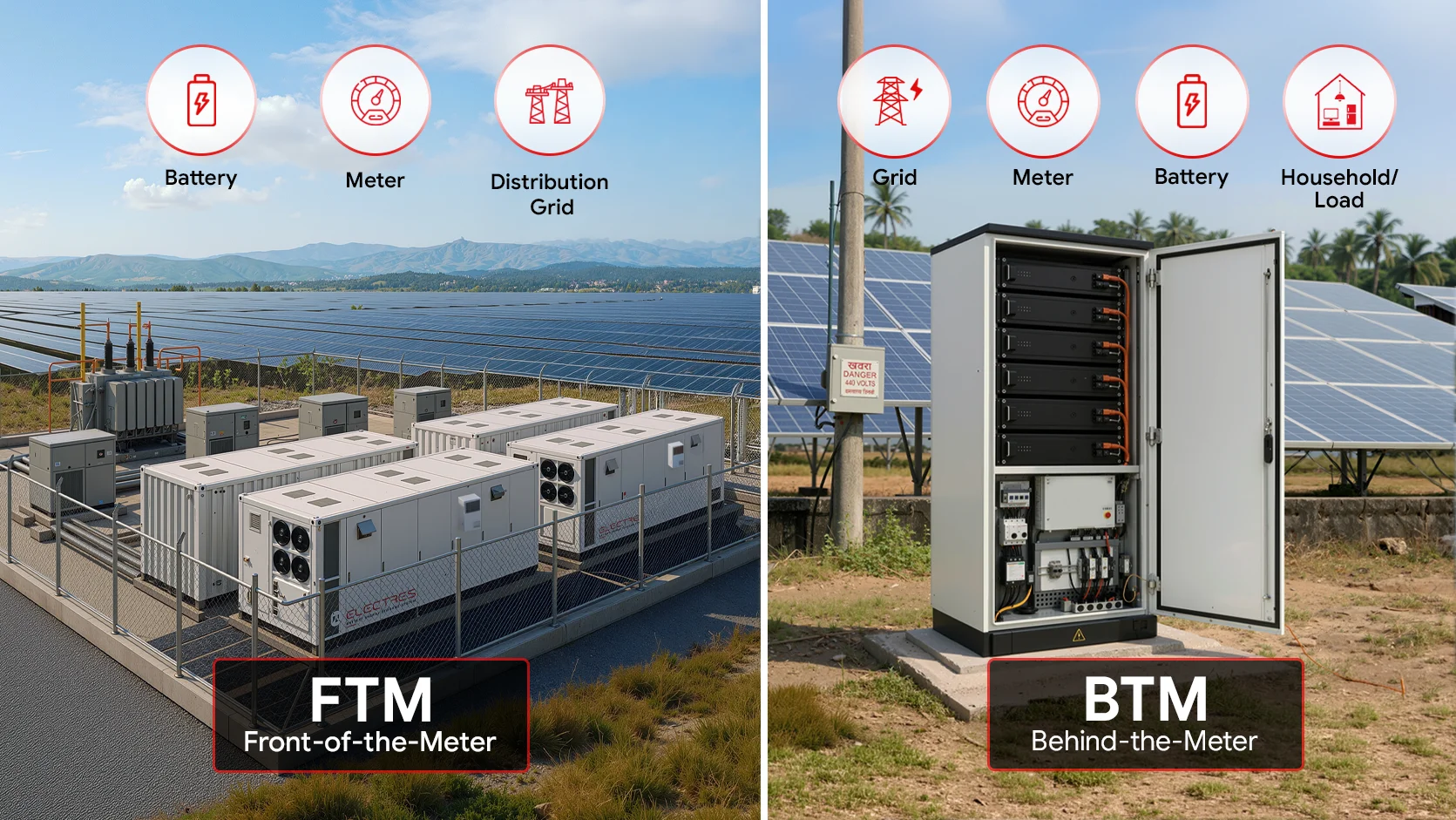
The stability of the power grid is no longer solely the responsibility of centralized utility companies. As energy storage becomes more common, the terminology can sometimes confuse facility owners and commercial investors. During project planning or vendor presentations, acronyms like BTM and FTM are frequently used. Understanding the physical and financial position of a storage asset is important. The utility meter serves as the dividing line for this positioning, determining the regulatory requirements, accessible revenue streams, and necessary hardware for a site.
The Role of the Utility Meter
TL;DR: The utility meter largely divides the energy storage landscape. Behind-the-meter (BTM) systems sit on the customer’s property to significantly reduce utility bills and provide isolated backup power. Front-of-the-meter (FTM) systems are large grid-scale installations operated by utilities to stabilize regional transmission networks and manage wholesale energy markets.
Before exploring BESS Components, we must first look at the dividing boundary line:
the utility revenue meter. This specific device tracks the energy flow between the regional power grid and the local property. Importantly, it acts as the billing and interconnection point between customer facilities and the electricity distribution network. Where you place the battery relative to this meter largely changes the system’s primary purpose.
Behind-the-Meter Storage (BTM): The Customer Advantage
Behind-the-meter storage exists primarily on the energy consumer’s side. Think of residential garages, commercial basements, hospital electrical rooms, or factory rooftops. The property owner buys, installs, and operates the system. In this architecture, the battery sits generally between the utility meter and the facility’s main breaker panel.
The primary goal of a BTM system is localized demand-side management. Industrial and commercial facilities face substantial demand charges. Utilities penalize these businesses for short spikes in power usage. A smart BTM system monitors the facility load. When heavy factory machinery spikes during a production run, the battery discharges quickly. This technique, called peak shaving, reduces peak demand measured by the utility meter. The facility effectively manages its consumption profile and avoids the penalty fee.
Key Applications for BTM Systems
- Peak Shaving: Discharging battery power during high-demand operating windows to significantly lower peak demand charges from the local utility provider.
- Time-of-Day Arbitrage: Charging the battery at night when grid electricity is relatively cheap. Discharging that stored energy during the afternoon when utility rates are higher.
- Solar Self-Consumption: Storing excess rooftop solar generation during midday instead of exporting it. The facility then consumes this power after sunset.
- Microgrid Islanding: Disconnecting from the main grid during rolling blackouts or severe weather events to keep critical operations running smoothly.
- EV Charging Buffer: Providing a localized power buffer for ultra-fast electric vehicle charging stations. This prevents the EV chargers from overwhelming the local grid connection.
The Financial Logic of BTM
For a commercial operator, a BTM battery is a defensive financial asset. It protects the business against volatile retail electricity prices. In many urban markets, behind-the-meter adoption is expanding to meet commercial demands for localized resilience, with businesses utilizing various types of Battery Energy Storage Systems to lower operational expenses. When you deploy a commercial battery energy storage system on your property, the return on investment comes primarily from avoided costs. The energy you do not buy during peak pricing benefits the bottom line.
Front-of-the-Meter Battery Systems (FTM): Grid Scale Power
What It Is
Front-of-the-meter battery installations operate primarily on the utility network side. These are large-scale installations commonly known as grid-scale energy storage plants. Utility companies, independent power producers, or specialized infrastructure funds own and operate these substantial assets.
Where It Is Installed
You will typically see these installations sprawling across acres of industrial land directly next to high-voltage substations or large-scale renewable generation sites. FTM setups require heavy, outdoor transmission infrastructure, large step-up transformers, and medium-voltage switchgear.
What Services It Provides
FTM systems do not power a single factory or a specific corporate campus; they supply the regional transmission grid. Their job is largely system-wide. When a large wind farm overproduces, the FTM battery absorbs the excess energy. When electricity demand increases during peak consumption periods, the battery releases that stored energy back into the high-voltage transmission lines. Furthermore, FTM systems are essential for renewable integration; they help balance solar generation variability, wind intermittency, and peak demand to maintain grid stability.
Market Insight: A front-of-the-meter battery essentially acts as a highly responsive dispatchable asset. It provides important frequency regulation, voltage support, and black-start capabilities. These systems respond to grid fluctuations in milliseconds, often replacing the spinning reserve role traditionally held by coal or gas peaker plants.
Revenue Sources
Unlike BTM systems that save money, FTM systems are designed to generate revenue by participating directly in wholesale electricity markets.
- Wholesale Energy Trading: Buying power from the grid when prices are low or negative, and selling that same power back to the grid during high-demand events.
- Ancillary Services: Getting paid by the grid operator to remain on standby. The battery provides frequency regulation to keep the grid balanced at 50Hz or 60Hz.
- Capacity Contracts: Signing long-term power purchase agreements with utilities to guarantee a specific amount of power delivery during periods of high demand.
Comparing the Architectures: Scale and Complexity
Scale generally dictates the engineering complexity. BTM systems prioritize compact physical footprints. They require integration with local building energy management software and must adhere to specific BESS safety standards for indoor installations. FTM setups require direct fiber-optic integration with regional grid operator networks.
Physical and Financial Divergence
| Attribute | Behind-the-Meter (BTM) | Front-of-the-Meter (FTM) |
|---|---|---|
| Physical Location | Customer side (Factories, Hospitals, Campuses) | Utility side (Substations, Generation Plants) |
| System Ownership | Business owners, Homeowners, ESCOs | Utility companies, Independent Power Producers |
| Typical Project Scale | Building, Campus, and Industrial Facilities | Grid-Connected Utility Projects |
| Primary Financial Driver | Bill reduction, local outage resilience, solar storage | Wholesale market arbitrage, frequency regulation |
| Interconnection Voltage | Low voltage (120 V to 480 V) | Medium to High voltage (11 kV to 132 kV+) |
| Space Requirements | Indoor electrical rooms, small outdoor pads | Acres of dedicated outdoor land |
Regulatory Hurdles and Interconnection
The boundary of the utility meter defines the regulatory environment. If you manage a large manufacturing plant, you cannot simply buy a utility-scale battery and plug it into your network. The hardware is typically incompatible with a low-voltage building network.
In India, the approval process is not the same for every BESS project. It depends on factors such as system capacity, voltage level, connection point, applicable interconnection standards, DISCOM requirements, and state regulations. For example, a small commercial BTM system usually has a much simpler approval process than a large utility-scale FTM project. BTM systems generally require local building approvals and distribution-level interconnection clearances. Larger FTM projects may require grid impact studies, transmission connectivity approvals, environmental clearances, and coordination with the relevant grid authorities. As a result, approval timelines and regulatory requirements vary from one project to another.
Software Integration and EMS Complexity
BTM EMS
Hardware is only half the equation. The Energy Management System (EMS) software powering these batteries differs based on their location. A BTM EMS is primarily focused on local data. It reads the facility load in real time. It monitors building schedules, local weather forecasts for solar prediction, and complex utility tariff structures. The software decides when to discharge to optimize local financial savings without disrupting facility operations.
FTM EMS
An FTM EMS is generally outward-facing. It communicates with the relevant utility or grid operator, depending on the country’s power system. In India, this may include utilities, State Load Dispatch Centres (SLDCs), Regional Load Dispatch Centres (RLDCs), or other authorized grid operators. The software follows dispatch instructions and helps operate the battery according to grid requirements. Depending on the project and local regulations, some FTM systems may also participate in electricity markets or provide ancillary services. Reliable communication is important for safe operation, regulatory compliance, and system performance.
India Context: Navigating the Divide
In India, understanding the distinction between BTM and FTM is particularly relevant due to the evolving energy landscape and local BESS regulations in India. FTM battery projects are being developed by utilities, DISCOMs (Distribution Companies), independent power producers, renewable energy developers, and other grid stakeholders to improve grid stability and support renewable energy integration. Meanwhile, C&I (Commercial and Industrial) facilities are increasingly adopting BTM systems to reduce electricity costs, improve solar self-consumption, manage time-of-day tariffs, and reduce dependence on diesel generators. The choice between BTM and FTM depends on project objectives, electricity tariffs, grid requirements, and applicable regulations.
The Role of Chemistry in Location
In the behind-the-meter vs. front-of-the-meter world, battery chemistry plays an important role. However, the right choice depends on the project’s requirements. Lithium Iron Phosphate (LFP) remains widely deployed for both BTM and FTM BESS because it offers a good balance of safety, long cycle life, and reliable performance. As detailed in comparisons of lithium-ion vs lead-acid batteries, LFP is used across commercial, industrial, and utility-scale projects.For long-duration energy storage (LDES), other technologies are also being evaluated. Flow batteries, including vanadium flow batteries, are designed to provide long discharge durations for grid-scale applications. Iron-air batteries are another LDES technology being explored for multi-hour and multi-day energy storage. While these technologies continue to develop, LFP remains the dominant choice for many BESS deployments today because of its proven commercial performance.
Conclusion
Both architectures are vital for modernizing our global power infrastructure. Consumers use BTM systems to reduce electricity costs through peak shaving, time-of-day tariff optimization, solar self-consumption, demand charge reduction, energy cost management, and backup power during outages. Grid operators use FTM systems to integrate intermittent renewables and maintain regional grid stability. Selecting between behind-the-meter storage and a front-of-the-meter battery should be based on project objectives, ownership, grid connection, and commercial requirements. Whether the objective is reducing electricity costs, improving energy resilience, or supporting grid scale energy storage, understanding the distinction between behind-the-meter storage and front-of-the-meter battery systems is essential for selecting the right BESS architecture. Evaluating project goals, site conditions, and grid requirements early in the planning process helps ensure long-term operational and commercial value.
FAQs
What is the difference between behind-the-meter (BTM) and front-of-the-meter (FTM) BESS?
Who typically uses behind-the-meter BESS?
Can the same battery technology be used for both BTM and FTM applications?
How do FTM battery systems support the electricity grid?
Can a business upgrade from a BTM system to a larger energy storage solution later?