What is the Depth of Discharge in Battery Storage?
Depth of Discharge determines how much stored battery energy can be used during operation and directly affects usable capacity, backup runtime, cycle life, warranties, and project economics. For C&I BESS, DoD must be assessed with SoC limits, reserve requirements, efficiency losses, thermal conditions, EMS strategy, and degradation. The best DoD is not the deepest possible discharge, but the operating window that balances performance, reliability, bankability, and long-term delivered energy value.
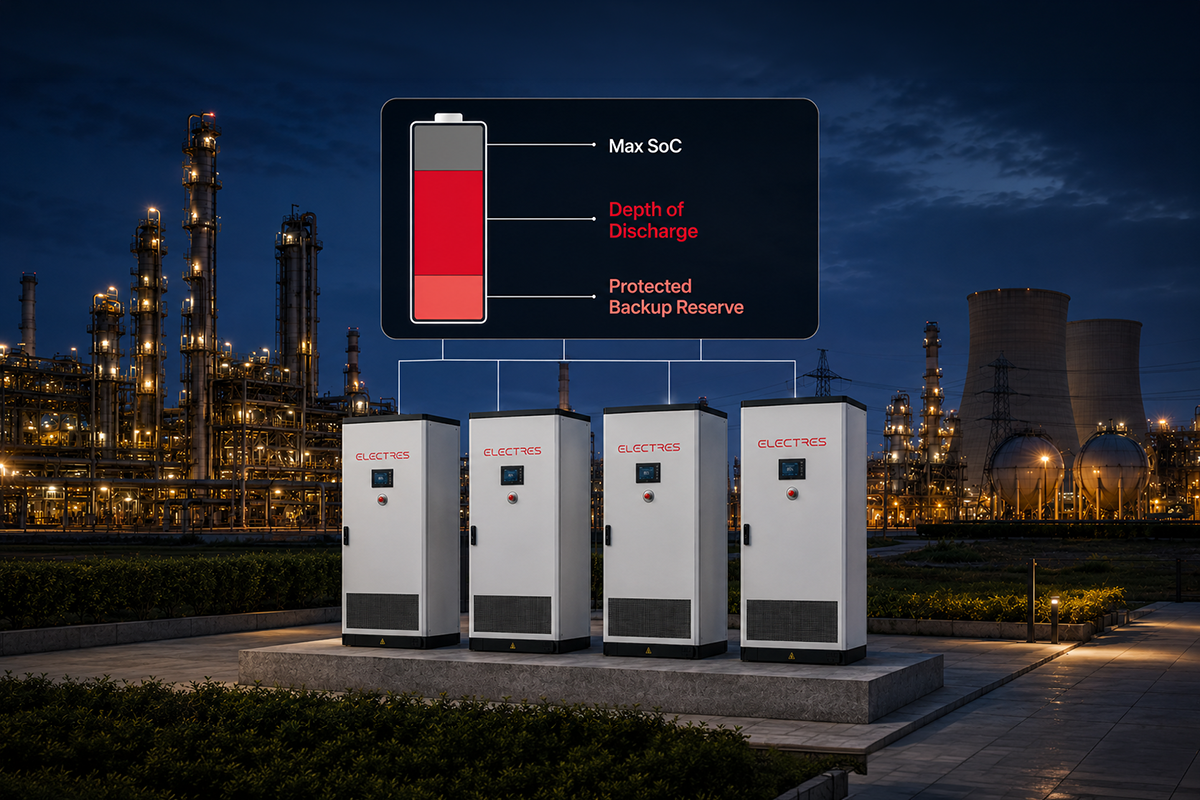
Depth of Discharge, or DoD, measures the proportion of stored energy discharged from a battery during operation. For commercial and industrial battery storage, it determines usable capacity, backup runtime, cycle life, warranty exposure, and levelised cost of storage. Two systems with identical capacity can deliver different value depending on DoD, SoC limits, reserve policy, thermal controls and EMS dispatch. With India’s BESS demand rising sharply, DoD becomes a critical design assumption for long-term reliable, bankable storage project performance outcomes.
DoD as a Dispatch Boundary Inside the SoC Window
Depth of Discharge is the percentage of battery capacity discharged from a defined full-charge point.
DoD (%) = 100% – SoC (%)
If a battery is at 30% SoC, it has reached 70% DoD. The definition is straightforward; the operational meaning requires closer attention in C&I projects.
A C&I BESS does not usually operate from 100% SoC to 0% SoC. The system is controlled within a practical SoC window. The minimum and maximum SoC, backup reserve, safety margins, current limits, temperature conditions, cell-balancing needs, and warranty requirements define this window.
For example, a system may support deep discharge, but the EMS may preserve 15% or 20% reserve for critical loads, emergency response, or long-term battery protection. In that case, the available energy for daily economic dispatch becomes lower than the theoretical DoD value shown in the product documentation.
A DoD number is incomplete unless the SoC window, reserve policy, C-rate, thermal range, and warranty basis are also defined.
Rated kWh Does Not Represent Dispatchable Energy.
One of the most common mistakes in C&I BESS procurement is comparing systems only by nominal or rated capacity. Nominal kWh represents the rated installed energy capacity. It is not the same as usable energy or dispatchable AC energy.
The basic calculation is:
Usable DC energy = Nominal battery capacity × Allowed DoD
A 1 MWh BESS operating at 80% DoD provides 800 kWh of usable DC energy before conversion losses and reserve logic. If the project also requires 15% backup reserve, the energy available for daily peak shaving or tariff optimization is further reduced.
Even after usable DC energy is calculated, the site-delivered AC energy can be affected by PCS efficiency, transformer losses, auxiliary consumption, HVAC demand, liquid-cooling auxiliary load, EMS reserve settings, and degradation allowance.
For this reason, a professional BESS comparison should not stop at cost per nominal kWh. C&I buyers should evaluate cost per usable kWh, cost per dispatchable kWh, and lifetime delivered energy. A system that looks attractive on rated capacity may not remain the most economical once reserve, derating, conversion loss, and long-term output are included.
Why Does A Higher DoD Not Automatically Mean A Better BESS?
A higher DoD can increase first-year usable energy, but it does not automatically create a commercially better operating strategy.
Deeper discharge increases the energy withdrawn per cycle and can alter the battery system’s stress profile depending on operating temperature, C-rate, SoC window, and cycling frequency. The actual impact depends on the cell platform, electrode design, thermal management, average SoC, charge-discharge pattern, and daily cycle frequency.
This is why DoD should not be judged as a standalone number. A 90% or 95% DoD claim may be valid for a specific LFP cell platform, but it still needs to be checked against the warranty, cycle limit, throughput allowance, and application profile. A battery used for occasional backup has a very different operating burden from a battery used for daily solar shifting or demand charge reduction.
The procurement question should not be, “How deep can this battery discharge?”
It should be, “How much energy can this BESS discharge repeatedly without weakening lifecycle economics?”
DoD, Cycle Life and SoH: The Degradation Triangle
DoD, cycle life, and State of Health should always be read together.
DoD defines how deep each cycle goes. Cycle life is the number of charge-discharge cycles the system can complete under specified conditions. SoH indicates how much usable capacity remains relative to the battery’s original state.
Degradation is not driven by DoD alone. It is affected by temperature, C-rate, dwell time at high SoC, operating window, cycling depth, rest periods, thermal management quality, and BMS accuracy.
For C&I projects, this matters because the system is expected to deliver useful energy not only in year one but across the warranty period. A battery may meet the required load profile today but fall short later if the sizing does not account for degradation and end-of-life capacity planning.
That is why DoD should be linked with year 10 or year 15 usable energy. A technically sound BESS design should answer a more practical question: how much usable capacity will remain after repeated cycling under the site’s actual duty cycle?
Peak Shaving, Load Shifting, and Backup Do Not Need The Same DoD Policy
Different C&I applications need different discharge behavior. A single universal DoD policy is rarely the best approach.
Peak Shaving
Peak shaving usually requires short, high-value discharge windows. The BESS may discharge only when site demand crosses a defined threshold. This does not always require deep daily discharge. A controlled DoD window can reduce demand charges while preserving long-term battery performance.
For this application, fast response, accurate load prediction, and EMS control are often more important than maximum discharge depth.
Load Shifting
Load shifting requires more predictable energy movement. The system charges during lower-tariff periods and discharges during higher-tariff periods. Here, the DoD window must match tariff spread, discharge duration, and charging availability.
If the discharge window is too shallow, the financial benefit may be limited. If it is too aggressive, the degradation-adjusted cost may increase.
Solar Self-Consumption
In solar-plus-storage projects, DoD is linked to PV surplus capture and evening load support. A deeper daily cycle may be useful when large daytime generation must be shifted into non-solar hours.
However, daily cycling should be validated against the cycle warranty and long-term usable capacity. The right operating window should be based on the solar generation curve, site load profile, and export limits.
Backup Power
Backup applications require reserve discipline. If the full DoD window is consumed for daily economic dispatch, the site may not have enough stored energy when backup is actually needed.
For critical operations, a fixed reserve SoC should be obtained from the energy used for peak shaving or tariff optimization.
DG Hybrid Operation
In diesel-plus-BESS systems, DoD must be aligned with generator start-stop logic, minimum loading, fuel-saving targets, and reserve energy. The BESS may reduce low-load diesel operation, absorb sudden load changes, and support smoother generator operation.
Here, DoD is part of the overall power control strategy, not just a battery setting.
Operational Assessment: When the Same 1 MWh BESS Delivers Different Dispatchable Value
For illustration, consider an industrial facility evaluating a 1 MWh BESS for peak shaving and limited backup support.
At 90% DoD, the system may offer 900 kWh of usable DC energy. At 80% DoD, the usable DC energy becomes 800 kWh. If the same 80% DoD system also reserves 15% capacity for backup, the energy available for daily economic dispatch may fall to approximately 650 kWh before AC-side losses, depending on how the reserve is configured.
This does not mean the system is underperforming. It means the battery is being operated with a defined reserve policy.
The most aggressive DoD number does not decide the commercial value. It is determined by usable energy after reserves, conversion losses, EMS logic, thermal conditions, and degradation allowances.
This is where the BESS evaluation becomes more technical than a capacity comparison. The correct design question is: how much energy can the system dispatch repeatedly while still protecting backup availability, warranty compliance, and long-term energy output?
How DoD Should Enter BESS Sizing Calculations
DoD directly affects BESS sizing.
Required nominal battery capacity = Required usable energy ÷ Allowed DoD
If a facility requires 800 kWh of usable energy and the system is designed around 80% DoD, the nominal battery capacity should be at least 1,000 kWh before accounting for losses and reserves.
But C&I sizing should go further. The final system capacity should also include PCS efficiency, backup reserve, auxiliary load, thermal derating, degradation buffer, future load growth, expected cycle frequency, end-of-life capacity target, solar generation profile, and 15-minute demand data.
A BESS sized only for first-year usable energy may appear correct during commissioning, but may underperform later in its project life. For industrial applications, the sizing process should account for the energy the asset can deliver after years of controlled cycling.
Warranty Language Matters More Than the Brochure DoD Number
DoD claims should always be checked against the warranty document, not only the product sheet.
Procurement and technical teams should verify:
- Which DoD is covered under warranty?
- What SoC operating range is permitted?
- Is the warranty based on years, cycles, MWh throughput, or all three?
- What annual equivalent cycle limit is allowed?
- What is the guaranteed end-of-life capacity?
- Is augmentation included or excluded?
- What C-rate and thermal range are assumed?
- Is the warranty valid under Indian ambient conditions?
- What happens if the EMS dispatches outside the recommended window?
- Are backup reserve and daily economic dispatch treated separately?
A DoD claim is bankable only when it is aligned with throughput, temperature, reserve policy, control logic, and warranty conditions.
How Electres Approaches DoD As A Project-Sizing Variable
Electres approaches Depth of Discharge as a project-sizing and operating variable, not just a specification on a datasheet. For C&I users, the DoD policy should be mapped against the site’s demand curve, tariff structure, backup requirement, solar generation profile, and expected cycling frequency.
The value of BESS is not only in installed capacity. It is in how intelligently that capacity is controlled, preserved, and dispatched across the project life.
Electres BESS solutions are designed to support usable capacity planning, lifecycle reliability, India-ready operating conditions, peak shaving, load shifting, solar integration, backup reserve planning, EMS-led dispatch logic, and long-term energy economics.
Before finalising BESS capacity, the DoD assumption should be tested against site-level 15-minute demand data, critical load requirements, daily operating pattern, and future energy needs. This helps ensure that the system is not only correctly sized on paper, but also commercially useful in operation.
For C&I facilities evaluating storage capacity, Electres can help assess the DoD window against actual demand data, backup reserve needs, and long-term operating economics before system sizing is finalised.
If usable energy, backup reserve, and lifecycle economics are creating sizing gaps, Electres BESS helps align DoD, EMS logic, and capacity with actual site demand.
Conclusion
Depth of Discharge is not only a technical percentage. In C&I battery storage, it affects usable energy, system sizing, cycle life, backup reserve, warranty exposure, LCOS, and long-term project economics.
The right DoD is not the one that looks most aggressive on the datasheet. The right DoD is the operating window that keeps the BESS useful across its actual duty cycle, warranty period, and operating environment.
For C&I decision-makers, DoD should be treated as a bankability assumption. It defines how much of the battery can be monetised, how much should be preserved and how confidently the asset can deliver over its operating life.
FAQs
What is a good DoD for C&I battery storage?
Is 90% or 95% DoD better than 80% DoD?
How does DoD affect BESS sizing?
How is DoD different from SoC?
Should the backup reserve be separate from the daily DoD?