Lithium Ion vs Lead Acid Batteries: Full Comparison
Lithium-ion and lead-acid batteries both support backup power, but they differ in efficiency, usable capacity, charging speed, lifespan, maintenance, space requirements, and long-term cost.Lithium-ion, especially LFP, is generally better suited for frequent cycling and commercial energy storage, while lead-acid remains relevant where lower upfront cost and infrequent use are priorities. The right choice depends on backup needs, inverter compatibility, system design, safety requirements, and total lifecycle economics.
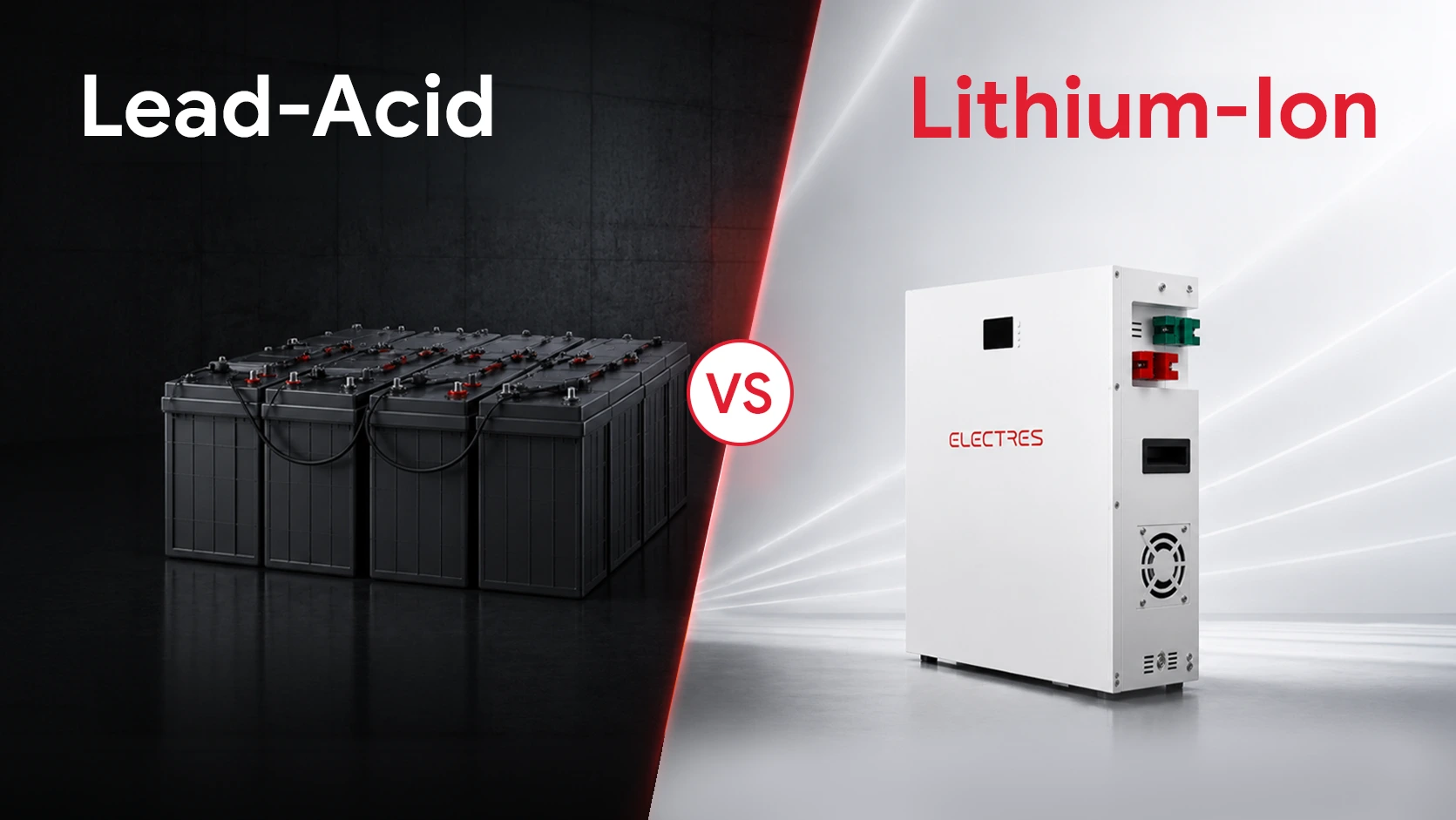
Manufacturing and digital operations can face disruptions from power interruptions, making battery selection an important part of business continuity planning. The right backup battery depends on more than rated capacity or upfront cost. Battery lifespan, usable energy, charging performance, efficiency, maintenance requirements, and long term operating costs can all influence the suitability of a system. Lithium ion and lead acid batteries can both provide backup power, but their performance characteristics differ across service life, usable capacity, charging behavior, energy density, maintenance requirements, and lifecycle economics. Lithium ion batteries have gained significant adoption in battery storage, while Lithium Iron Phosphate (LFP) has become the dominant chemistry in new battery storage deployments. The International Energy Agency reports that LFP batteries accounted for around 90% of battery storage deployments in 2025. Lead acid remains relevant for applications where lower initial investment and established technology are important considerations. This guide compares Lithium Ion vs Lead Acid Batteries across key performance, operational, and cost factors to help businesses select an appropriate backup power battery storage solution.
Core Chemistry and Operational Characteristics
The chemistry inside a battery influences its charging behavior, service life, maintenance needs, and overall performance. Electricity in lead-acid batteries is generated through a chemical reaction between lead plates and sulfuric acid. This technology has been used for decades because of its proven reliability and relatively low acquisition cost. However, repeated deep discharge gradually damages the lead plates, reducing battery capacity and shortening operational life.
Lithium-ion batteries operate by transferring lithium ions between the anode and cathode during charging and discharging. This process allows the battery to charge faster, store more energy, and perform well over repeated charge and discharge cycles. Among lithium-ion chemistries, Lithium Iron Phosphate (LFP) is the preferred choice for stationary energy storage because of its thermal stability, long cycle life, and reliable performance. Unlike conventional lead-acid batteries, LFP systems are designed to withstand repeated charge and discharge cycles with minimal capacity loss. This makes them suitable for commercial facilities, industrial operations, and renewable energy integration.
Understanding the Importance of Depth of Discharge
A battery’s rated capacity does not represent the amount of energy that can be used in everyday operation. The usable capacity depends on its depth of discharge (DoD), which is the percentage of stored energy that can be safely discharged before recharging. A higher DoD allows more of the battery’s rated capacity to be used without significantly reducing its service life.
Lithium Iron Phosphate (LFP) batteries can generally operate at a depth of discharge of 80 to 90 percent while maintaining long-term performance. Lead-acid batteries, on the other hand, are typically limited to a depth of discharge of 50 to 60 percent to reduce degradation and extend service life. Understanding DoD helps organizations evaluate usable battery capacity instead of relying only on nameplate ratings when selecting Backup Power Battery Storage.
Upfront Cost vs. Long-Term Cost
The purchase price is only one part of a battery system’s overall cost. Battery life, maintenance requirements, replacement frequency, and energy efficiency all influence the total cost of ownership.
Lithium-ion batteries require a higher upfront investment but generally offer a longer service life, higher efficiency, and lower maintenance requirements. As global battery prices continue to decline, the gap in total cost of ownership between lithium-ion and lead-acid systems has narrowed. Lead-acid batteries often have a lower initial cost, making them attractive for environments with occasional outages. However, their shorter service life, lower usable capacity, routine maintenance, and more frequent replacements can increase long-term operating expenses.
| Metric | Lead-Acid (VRLA) | Lithium-Ion |
|---|---|---|
| Initial Cost | Lower | Higher |
| Usable Capacity | Lower at comparable rated capacity | Higher at comparable rated capacity |
| Typical Cycle Life | Shorter | Longer |
| Expected Service Life | Shorter | Longer |
| Maintenance | Low, with periodic inspection and testing | Minimal, with electronic monitoring |
| Charging | Slower | Faster |
| Round-Trip Efficiency | Lower | Higher |
| Energy Density | Lower | Higher |
| Space Requirement | Larger footprint | More compact |
| Typical Application | Backup applications where low initial cost and infrequent cycling are priorities | Applications requiring frequent cycling, higher usable capacity, and longer service life |
The lifecycle comparison shows why the purchase price alone does not reflect the true cost of a battery system. Organizations with frequent charge and discharge cycles often recover the higher initial investment in lithium-ion batteries through lower maintenance requirements, fewer replacements, and higher energy efficiency over the system’s operating life. Operations that support renewable energy or require extended backup typically place greater value on this long-term operational stability. Conversely, lead-acid remains a practical option for applications where outages are rare and minimizing initial capital is the strict priority.
Charging Speed and Round-Trip Efficiency
Cost is only one aspect of battery performance. Charging behavior also influences how effectively a backup system operates during repeated outages. In many facilities, one outage may be followed by another before batteries have fully recharged. Recharge time therefore becomes an important consideration, particularly for sites using rooftop solar systems for battery charging.
Lithium-ion batteries recharge quickly while maintaining high efficiency. Many commercial Lithium Iron Phosphate (LFP) systems can recharge within a few hours, depending on battery capacity and charger configuration. They also achieve higher round-trip efficiency, allowing more stored electricity to be recovered after every charging cycle. When paired with rooftop solar, faster charging helps capture more daytime generation for later backup use. Lead-acid batteries recharge gradually through a controlled charging profile designed to limit overheating and battery degradation. While this approach protects battery health, it also extends the time needed to restore full capacity.
Inverter Compatibility and System Integration
Replacing a lead acid battery with a lithium ion system can require changes to charging, protection, and control parameters, so inverter compatibility should be confirmed before an upgrade. Lithium ion and lead acid batteries can have different voltage ranges, charging requirements, protection limits, and communication requirements. Organizations should verify the battery’s voltage and current requirements, charging profile, protection settings, communication protocol, and compatibility with the specific inverter before replacing an existing battery bank. Firmware updates or equipment replacement may be required depending on the system configuration.
The Battery Management System (BMS) is a separate control and protection component within a lithium ion battery system. It monitors parameters such as cell voltage, current, temperature, and state of charge and can initiate protective actions when operating conditions exceed defined limits. In compatible systems, the BMS can also communicate battery status and operating information to the inverter or energy management system. Commercial Battery Storage systems may therefore integrate the battery, BMS, inverter, and energy management controls as coordinated components. The exact architecture varies by manufacturer and application, so compatibility should be confirmed using the technical documentation for the specific battery and inverter combination.
Thermal Management and Safety
Safe battery operation depends on both the battery technology and the conditions in which it operates. Flooded lead-acid batteries can release hydrogen gas during charging and generally require adequate ventilation. Depending on the battery type, routine maintenance may also include electrolyte inspection and water replenishment. Although Valve Regulated Lead Acid (VRLA) batteries reduce maintenance requirements, they still require operation within specified charging and temperature limits.
Commercial stationary lithium-ion systems continuously monitor voltage, current, and temperature through an integrated Battery Management System (BMS). Many systems also include thermal management and protection features that respond automatically to abnormal operating conditions. Regardless of the battery technology used, safe operation requires proper system design, adequate ventilation, periodic inspections, and compliance with applicable electrical, fire safety, and manufacturer installation standards.
Space Requirements and Installation
Installation space is another factor that influences battery selection, particularly in commercial buildings, manufacturing facilities, and data centers. Lithium-ion batteries store more energy within a smaller footprint because of their higher energy density. As a result, they generally require fewer battery cabinets and can simplify installation where available space is limited.
Lead-acid batteries have lower energy density, which means more floor space is required to provide the same usable backup capacity. Their higher weight may also increase structural requirements during installation. Although every project requires a site-specific engineering assessment, the compact footprint of lithium-ion technology has contributed to its wider adoption in commercial Backup Power Battery Storage applications.
BESS Market Trends
Battery energy storage deployment continues to increase as utilities, industries, and commercial facilities invest in reliable and flexible power infrastructure.
According to the International Energy Agency (IEA), battery storage is among the fastest-growing energy technologies worldwide. Declining battery costs, manufacturing improvements, and expanding renewable energy capacity have accelerated the adoption of lithium-ion systems for stationary storage. Lithium Iron Phosphate (LFP) batteries account for most new battery energy storage installations because they combine competitive costs with long cycle life and stable operating performance.
Lead-acid batteries continue to serve applications where backup systems operate infrequently and lower upfront investment remains the primary consideration. However, facilities that depend on regular battery cycling, higher usable capacity, and lower maintenance requirements increasingly adopt lithium-ion technology because of its lower lifetime operating costs.
Conclusion
Both technologies provide reliable backup power when selected according to the intended application. Organizations with occasional backup requirements may find lead-acid batteries appropriate due to lower initial capital requirements.
However, for most commercial, industrial, and renewable energy applications, lithium-ion technology has become the preferred choice for Backup Power Battery Storage. It delivers higher efficiency and longer service life, supporting dependable power outage battery solutions while streamlining facility operations.
References
- International Energy Agency (IEA). Batteries and Secure Energy Transitions, 2024. https://www.iea.org/reports/batteries-and-secure-energy-transitions
- International Energy Agency (IEA). Status of Battery Demand and Supply, 2024. https://www.iea.org/reports/batteries-and-secure-energy-transitions/status-of-battery-demand-and-supply
- International Energy Agency (IEA). Global EV Outlook 2026: Electric Vehicle Batteries (Stationary storage trends and LFP adoption).
Frequently Asked Questions
How much does a lithium battery cost?
How many batteries do I need?
What is the ROI of lithium batteries?
Which battery is best for a solar system?