What Is C-Rate in Battery Energy Storage Systems?
C-rate measures how quickly a battery charges or discharges relative to its total capacity. A 1C rate means the battery fully charges or discharges in 1 hour, while 0.5C takes 2 hours. In a BESS, C-rate determines the system's power delivery capability and application suitability.
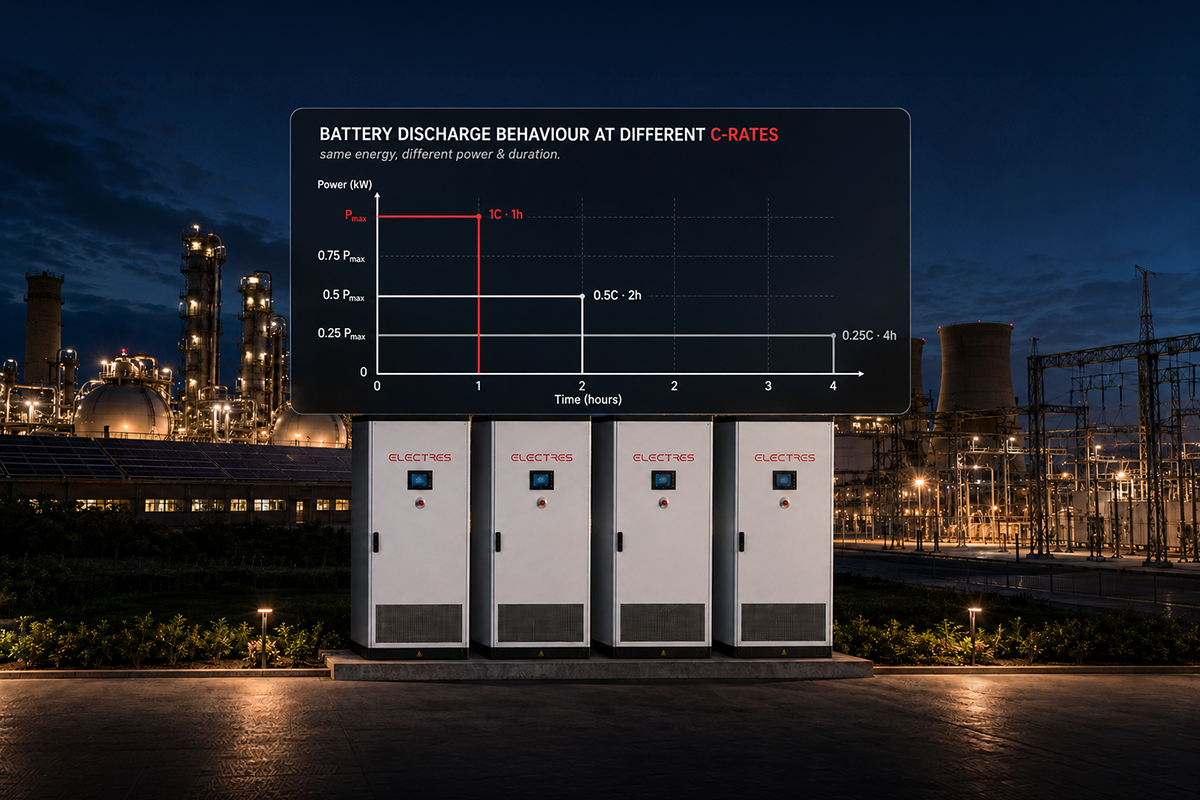
In battery energy storage systems, C-rate is often treated as a datasheet parameter. In C&I projects, it functions as a project-level design constraint.
C-rate determines how fast a BESS can charge or discharge relative to its energy capacity.
More importantly, it affects how the system performs under peak demand, time-of-day (TOD) tariff shifting, diesel generator offset, renewable integration, backup operation, thermal stress, and warranty-defined operating limits.
For commercial and industrial facilities, the question is not simply, “What is the C-rate?” The better question is, “Does this C-rate match the site’s power requirement, discharge duration, operating temperature, PCS rating, and commercial objective?”
That is where C-rate becomes a system design decision rather than merely a battery term.
C-Rate as a Power-to-Energy Ratio in BESS Design
At the cell level, C-rate expresses the relationship between battery current and rated capacity. In BESS design, it is commonly interpreted through the relationship between power and energy.
- A 0.25 °C system generally aligns with a 4-hour discharge profile at rated power.
- A 0.5 °C system generally aligns with a 2-hour discharge profile at rated power.
- A 1C system generally aligns with a 1-hour discharge profile at rated power.
| C-Rate | Indicative Discharge Duration | Common BESS Fit |
|---|---|---|
| 0.25C | Around 4 hours | Long-duration shifting, backup support, and renewable energy shifting |
| 0.5C | Around 2 hours | Peak shaving, TOD shifting, DG offset, C&I load support |
| 1C | Around 1 hour | High-power demand response, short peak control, fast discharge applications |
These duration values are indicative. Actual AC-deliverable duration depends on usable energy, PCS rating, state-of-charge (SOC) limits, auxiliary load, thermal conditions, and EMS settings.
In C&I projects, buyers often discuss duration because it is easier to connect with use cases. Engineering teams evaluate deeper system constraints. They assess whether the BESS can deliver the required kW for the required time, under the required operating conditions, without accelerating degradation or violating warranty assumptions.
C-Rate, Discharge Duration, and E/P Ratio Are Not Separate Decisions
C-rate, discharge duration, and energy-to-power ratio are connected. A system cannot be judged solely by kWh capacity or kW output.
A high-energy battery with insufficient power capability may not control sharp demand spikes. A high-power battery with limited energy may discharge too quickly to cover a complete peak-tariff window. The commercial value comes from matching both power and duration to the site-level operating problem.
For peak shaving, the BESS may need a fast response for short intervals. For time-of-day shifting, it must sustain discharge across a longer tariff window. For DG offset, it must manage load transitions without forcing unnecessary cycling. For solar-plus-storage, it must absorb surplus generation and dispatch it when the site or grid needs it.
This is why C-rate should be reviewed together with E/P ratio, PCS sizing, usable energy, and EMS dispatch strategy.
Why System-Level C-Rate Is Different from Cell-Level C-Rate
Cell-level C-rate does not automatically become system-level C-rate. A battery cell may be tested under controlled conditions, but an installed BESS is a complete electrical and thermal system.
DC Battery Block Limits
The DC-side capability depends on chemistry, cell format, module design, rack configuration, BMS controls, internal resistance, SOC window, and allowable operating current. These factors define how much power the battery block can safely deliver or absorb across its usable operating range.
PCS and AC Output Limitations
Even if the battery block has strong DC-side capability, the PCS may limit the real AC export power. Transformer limits, interconnection constraints, grid code settings, and EMS rules can further reduce the actual site-deliverable output.
For this reason, C&I buyers should not rely only on the cell or rack-level C-rate. They should ask what the system can continuously deliver at the AC point of interconnection.
Thermal Derating Under Real Operating Conditions
Higher C-rate increases current flow, which increases heat generation. In high-ambient-temperature industrial environments, thermal management becomes a performance issue, not just a safety feature.
Liquid cooling, HVAC design, cabinet airflow, sensor placement, and thermal uniformity affect the system’s ability to sustain rated performance. A BESS that performs well under controlled test conditions may derate when exposed to industrial heat, dust, cycling frequency, or poor installation conditions.
Warranty-Defined Operating Windows
The usable C-rate must also be checked against warranty conditions. Cycle count, depth of discharge, SOC range, temperature range, annual throughput, average C-rate, and continuous vs peak power ratings all matter.
A system may be technically capable of higher power, but if that operating pattern reduces warranted life, it may not be commercially optimal.
How C-Rate Changes C&I BESS Application Fit
C-rate selection should begin with the application, not the product catalog.
Peak Shaving and Short-Duration Demand Control
For facilities with sharp demand spikes, higher power response may be valuable. However, peak shaving does not always require long-duration storage. The correct C-rate depends on how long the peak lasts, how the utility measures demand, and how often the spike repeats.
A 15-minute demand profile can reveal whether the site needs high-power short-duration discharge or a more balanced energy-duration profile.
When recurring demand spikes are the problem, the solution is not simply a larger battery. The stronger approach is to size BESS power, usable energy, PCS output, and EMS control around the exact demand interval that creates the billing impact.
Time-of-Day Shifting and Tariff-Window Matching
TOD optimization requires duration discipline. A high C-rate system may discharge quickly but fail to cover the full expensive tariff window. A lower C-rate system with more usable energy may offer greater commercial value if the site requires sustained discharge during evening or peak-rate periods.
The goal is not maximum discharge speed. The goal is controlled discharge during the most expensive hours.
DG Offset and Transient Load Support
In many industrial facilities, diesel generators are used to manage outages, voltage events, or unstable supply. A BESS can reduce DG cycling, fuel consumption, and operational wear, but the C-rate must be selected carefully.
The battery must respond fast enough to support load transitions, yet the EMS should avoid unnecessary high-rate cycling that shortens battery life. In DG offset applications, dispatch quality matters as much as charge/discharge power capability.
Solar-Plus-Storage and Renewable Smoothing
For solar-plus-storage projects, C-rate affects how much surplus solar energy can be absorbed and how effectively it can be discharged later. If the charge power is too limited, solar limiting may increase. If the discharge duration is too short, the system may not support the evening load profile.
The right C-rate depends on the solar generation curve, site load curve, inverter capacity, export constraints, and intended renewable-shifting strategy.
Backup Power and Uptime-Critical Loads
Backup applications require more than kWh capacity. The BESS must support instantaneous load response, priority-load segmentation, PCS capability, and runtime expectations.
A 1C system may deliver strong power for a short window. A 0.5 °C or 0.25 °C design may support longer runtime but may need careful PCS sizing to manage large load steps. For uptime-critical operations, C-rate and load prioritization should be designed in tandem.
Practical C&I Sizing Example
Consider a manufacturing facility with repeated demand spikes at shift start, rooftop solar generation during the day, high evening tariff exposure, and partial dependence on DG during unstable grid conditions.
The wrong approach is to ask for the highest C-rate battery. The right approach is to study 15-minute demand data, identify the peak duration, calculate the usable energy required for demand control, check the TOD discharge window, review DG operating patterns, and size the BESS for both kW response and kWh endurance.
In this case, a 1C design may support aggressive peak clipping but may overshoot the economic requirement if the site only needs short interval control. A 0.5 °C design may offer a stronger balance for two-hour peak support, DG offset, and evening tariff management. A 0.25 °C design may support longer-duration energy shifting but may not be suitable for sharp peak response unless the PCS power is adequately sized.
The key point is simple: C-rate selection is a modeling decision, not a catalog preference.
Where Higher C-Rate Stops Adding Value
A higher C-rate is not automatically better. It is valuable only when the application pays for a high-power response.
Thermal Stress and Cooling Demand
Higher current increases thermal stress. As C-rate rises, thermal design becomes more important. Poor thermal control can lead to derating, uneven cell aging, reduced efficiency, and higher auxiliary energy consumption.
Degradation, Internal Resistance, and Cycle Life Impact
Aggressive charge and discharge rates can increase battery stress, especially when combined with high temperature, deep cycling, high SOC, low SOC, or frequent cycling. Over time, internal resistance increases and usable capacity declines.
This is why system design should not maximize C-rate without evaluating lifecycle cost.
Charge C-Rate Vs Discharge C-Rate
Charge C-rate and discharge C-rate should not be treated as equal. Fast charging can be more degradation-sensitive, especially near the upper SOC range. For solar-plus-storage and TOD applications, controlled charging is often more important than simply accepting maximum available input.
LFP and NMC Considerations in Stationary BESS
LFP is widely preferred for stationary storage applications because of its safety profile, thermal stability, cycle life, and cost-effectiveness. But chemistry alone does not remove the need for correct C-rate selection. LFP systems still require disciplined thermal management, SOC control, EMS logic, and warranty-aligned operation.
What C&I Buyers Should Ask Before Accepting a C-Rate Claim
Before accepting any C-rate claim, technical and procurement teams should ask specific questions.
Is the C-rate continuous or peak-rated? A short-duration peak rating is not the same as continuous dispatch at rated power.
Is the rating based on nominal or usable capacity? Nominal DC capacity can overstate project-level performance if reserve settings, SOC limits, and losses are ignored.
What is the AC-deliverable duration? Buyers should check the output after accounting for PCS losses, transformer losses, auxiliary consumption, HVAC demand, reserve settings, and EMS constraints.
What temperature range supports the rating? Rated performance should be reviewed under realistic ambient and operating conditions.
What does the warranty actually allow? Cycle count, average C-rate, DoD, SOC window, annual throughput, operating temperature, and performance guarantee conditions should be reviewed before final selection.
How does EMS protect the operating envelope? A well-configured EMS should meet dispatch objectives while protecting battery life, thermal limits, SOC range, and warranty compliance.
How Electres Approaches C-Rate as a Project-Level Design Variable
At Electres, C-rate is treated as a system-design decision, not a standalone datasheet value. It is evaluated as part of the complete storage architecture: usable energy, power conversion, thermal management, EMS logic, site load profile, DG dependency, tariff window, and long-term operating reliability.
This approach is important for Indian C&I environments where demand spikes, diesel dependence, renewable intermittency, high ambient temperatures, and grid instability often exist together. In these conditions, a BESS must do more than store energy. It must deliver controlled, predictable, and commercially useful power.
Electres positions BESS design around real operating problems: peak shaving, DG offset, uptime protection, TOD optimization, and renewable integration. The objective is not to prioritize the highest possible C-rate in isolation. The objective is to align C-rate, duration, PCS rating, and EMS strategy with the commercial outcome the site needs.
For facilities facing recurring demand spikes, DG cycling, high-tariff windows, or unstable renewable output, the C-rate should be evaluated as part of a comprehensive BESS design. Electres supports this evaluation by connecting battery power, usable energy, PCS capacity, EMS logic, and site-level operating conditions.
Conclusion
C-rate determines how quickly a BESS can deliver energy. But C&I value depends on whether that speed matches the load profile, tariff structure, backup requirement, PCS capacity, thermal conditions, and warranty limits.
A poorly matched C-rate can create a system that appears powerful on paper but underperforms in practice. A well-matched C-rate helps deliver usable power, protect battery life, support warranty compliance, and improve long-term project economics.
For industrial buyers, the right BESS is not always the one with the highest C-rate. It is the system whose power, duration, control logic, and lifecycle performance are engineered around the actual operating problem.
FAQs
What Is the Ideal C-Rate for C&I BESS?
Is 0.5 °C Better Than 1 °C for Commercial Battery Storage?
How Does C-Rate Affect Battery Life?
Why Do OEMs Market BESS by Duration Instead of C-Rate?
Should C-Rate Be Calculated on Nominal or Usable Capacity?
How Does PCS Sizing Affect System C-Rate?
How Does Electres Evaluate the Right C-Rate for C&I BESS Projects?