What Is Round-Trip Efficiency in Battery Energy Storage Systems?
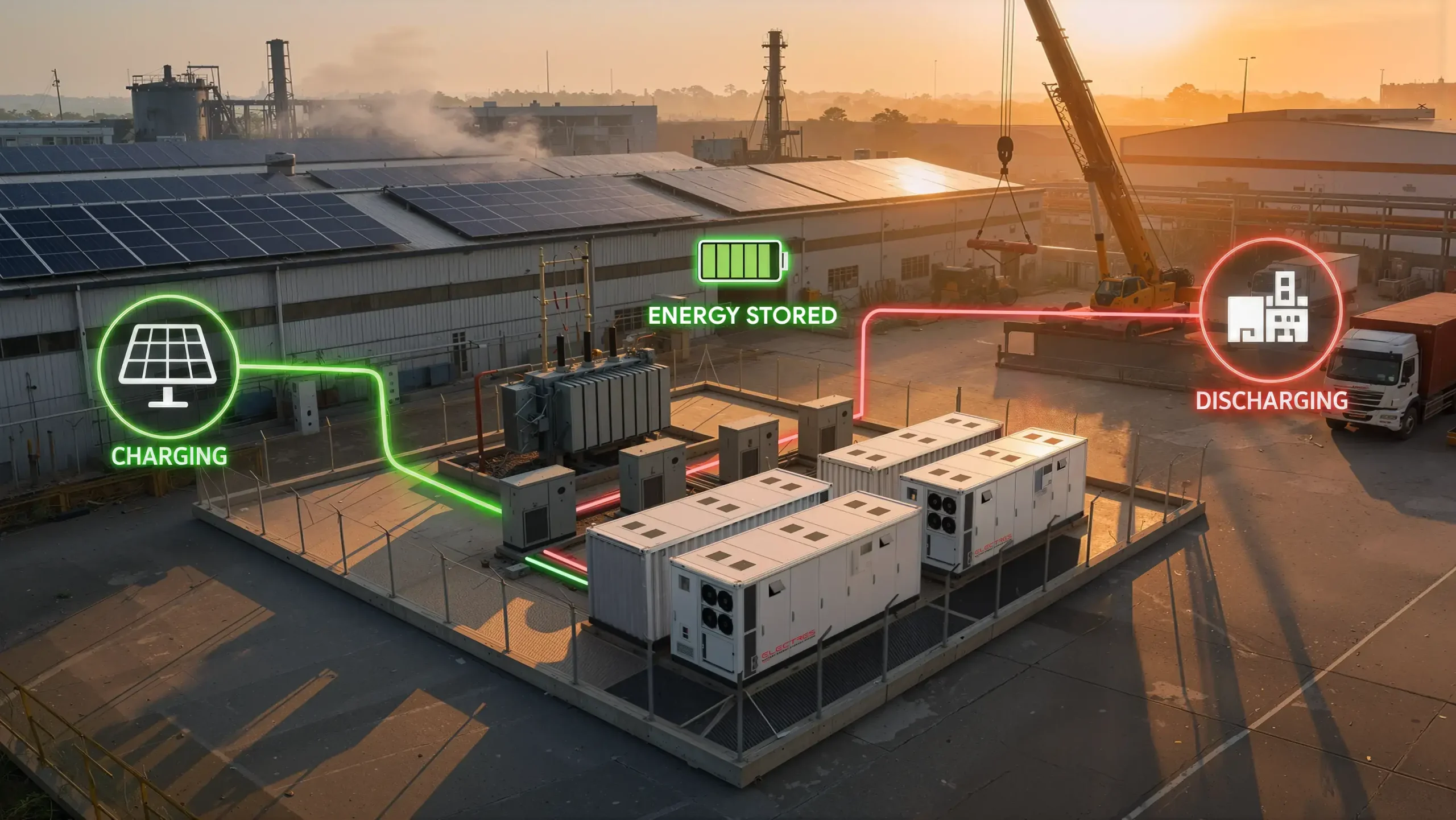
Round-trip efficiency is one of the most-referenced performance metrics in battery energy storage system specifications. Still, in commercial, industrial, and utility-scale projects, the number is useful only when read in the right context.
For C&I decision-makers, RTE is not simply a measure of how efficiently a battery charges and discharges. It indicates how much of the energy sent into the storage system can be recovered as usable output after accounting for system-level losses, such as power conversion, thermal management, auxiliary consumption, standby load, and operating conditions.
This distinction matters because BESS economics are built on deliverable energy, not theoretical stored energy. Peak shaving, time-of-use optimization, diesel generator offset, solar utilization, power continuity, and lifecycle cost all depend on the amount of usable AC energy the system can provide at the facility boundary.
A high RTE value may look strong in a datasheet. However, if the measurement boundary, duty cycle, power conversion system (PCS) losses, HVAC load, ambient conditions, and long-term performance assumptions are not clearly defined, the number may not reflect the actual on-site efficiency achieved.
Why RTE Should Be Read as a System Performance Metric, Not a Battery Claim
Round-trip efficiency (%) = AC or DC energy delivered during discharge ÷ energy absorbed during charging × 100, measured across the same boundary, over a cycle that begins and ends at the same state of charge.
At the project level, the important question is not only how efficient the battery cells are. The more important question is how much usable energy reaches the facility or the grid after accounting for all system-level losses.
This is where many BESS comparisons become incomplete or misleading. A battery-module efficiency value, a DC-block efficiency value, and a full AC-side system efficiency value are not interchangeable. They describe different measurement boundaries.
DC-Level Efficiency Does Not Represent Site-Level Performance
DC-level RTE can be useful for evaluating the battery block, chemistry, and internal electrical behavior. But a C&I project is not settled at the cell terminal.
The facility receives AC power after the energy has passed through the battery management system, DC cabling, PCS, transformer, switchgear, controls, and, in many cases, thermal management systems.
If the efficiency claim stops at the DC level, it does not fully represent the energy available at the plant’s electrical boundary. For procurement teams, that difference matters because the business case depends on usable output, not theoretical storage behavior.
AC-AC RTE Is the More Practical Commercial Reference Point
For most C&I projects, AC-AC round-trip efficiency is the more practical reference. Energy is imported, exported, billed, measured, and dispatched on the AC side.
Demand charges, grid interconnection, solar export limits, and load-serving requirements are also AC-side realities.
A BESS used for peak shaving, solar shifting, or DG offset should therefore be evaluated based on the energy it can deliver at the defined AC measurement point.
Any proposal that quotes RTE without clarifying whether it is DC-DC, DC-AC, PCS output, or point of common coupling (PCC) level should be treated as incomplete.
The Measurement Boundary Changes the Business Case
A 1% to 2% difference in RTE may seem small, but over thousands of cycles and multiple years of operation, it can affect the delivered MWh, the levelized cost of storage (LCOS), and the financial model.
That is why the measurement boundary should be defined clearly in every technical specification.
The buyer should know whether the number is measured at the battery terminals, the PCS output, the low-voltage panel, the transformer output, the point of common coupling, or the point of interconnection. Without that clarity, the number cannot be compared fairly across vendors.
The Loss Stack Behind Real BESS Round-Trip Efficiency
A single loss does not reduce round-trip efficiency. It is the combined effect of electrochemical, electrical, thermal, and operational losses across the BESS architecture.
Cell Impedance, SOC Window, and C-Rate Behavior
At the cell level, energy is lost through internal resistance, heat generation, and electrochemical behavior during charging and discharging.
The operating C-rate, depth of discharge, temperature, and state of charge (SOC) window all affect energy efficiency.
A system operating at high charge or discharge rates may show different efficiency behavior than one operating on slower daily cycling. Similarly, a BESS maintained within a tighter SOC window for backup readiness or battery health may not operate in the same efficiency band as a system designed for deep daily cycling.
This is why RTE should not be viewed as a fixed number. It is connected to how the asset is used.
PCS Conversion, Transformer and AC-Side Losses
The power conversion system is one of the most important contributors to real-world RTE.
In a grid-connected BESS, stored DC energy must be converted into AC power. When the system charges, AC power is converted back into DC. Each conversion stage introduces losses.
Additional losses may occur through DC cabling, switchgear, isolation equipment, transformers, protection systems, and metering points.
These losses are not always visible in battery-level efficiency claims, but they directly affect the energy delivered to the C&I load.
For high-duty projects, PCS architecture and conversion efficiency should be reviewed alongside battery chemistry. A stronger BESS evaluation treats the battery and power conversion system as a single operating platform rather than separate components.
HVAC, Auxiliary Loads, and Standby Consumption
Auxiliary consumption is one of the most commonly underestimated factors at the site level in RTE.
HVAC, fans, pumps, fire safety systems, controls, battery management system (BMS), energy management system (EMS), communication equipment, and monitoring hardware all consume energy.
In hot industrial environments, thermal management becomes more than a safety feature. It directly affects both battery performance and system efficiency.
A poorly-matched or undersized thermal system can increase auxiliary load, reduce usable energy, and create uneven operating behavior throughout the asset’s life.
Standby consumption also matters. Many C&I systems are not cycling continuously. They may remain on standby for peak events, grid interruptions, or backup support. In those conditions, auxiliary energy can become a more visible part of the total loss profile.
EMS Dispatch Logic and Partial-Cycle Losses
The energy management system can influence the effectiveness of RTE by determining when, how deeply, and how frequently it charges or discharges.
A capable EMS does more than move energy from one hour to another. It manages the asset around tariff windows, load peaks, solar availability, battery constraints, and site priorities.
Partial cycles, short-duration discharges, unnecessary top-ups, or inefficient charge timing can reduce the system’s commercial value even when the hardware itself is robust.
For C&I projects, RTE should be evaluated alongside the dispatch strategy, not separately.
Why Field RTE Often Differs from Datasheet RTE
Datasheet efficiency is usually measured under controlled conditions. Site realities shape field performance.
This is where experienced BESS buyers distinguish between specification quality and project quality.
Standard Test Conditions Do Not Always Match C&I Operations
A controlled test environment may assume defined temperature, defined power levels, stable operating conditions, and a clean charge-discharge cycle.
A live industrial facility behaves differently.
Manufacturing loads may spike unpredictably. Solar generation may vary with cloud cover. Grid interruptions may force backup operation.
The BESS may be asked to support peak shaving one day, uptime another, and tariff optimization the next. A single RTE figure cannot represent all these operating modes with equal accuracy.
Temperature, Dust, and Thermal Loads Matter in Indian Sites
For Indian C&I sites, ambient conditions should not be treated as a secondary detail.
High temperatures, dusty environments, and long operating hours can increase thermal management demands and affect system-level efficiency.
This does not mean the project becomes less viable. It means the design must reflect actual site conditions.
Thermal architecture, enclosure design, HVAC sizing, cell chemistry, EMS logic, and maintenance planning must match the site conditions. Otherwise, the efficiency used in the financial model may be higher than what the system actually achieves in operation.
Low-Throughput Backup or Peak-Shaving Systems Can Show Lower Effective RTE
A BESS used for daily energy shifting usually has a higher throughput. A system used mainly for peak shaving or backup may have lower throughput but still consumes standby and auxiliary energy.
As a result, the effective site-level RTE can appear lower, especially if the system discharges only for short events.
This is why throughput assumptions are important. The same BESS can exhibit different effective efficiencies depending on whether it is used for daily solar shifting, occasional peak shaving, grid support services, or backup readiness.
Solution Bridge: Evaluate the BESS Around the Site Reality
When the site challenge includes short demand spikes, DG dependency, solar variability, high ambient temperature, or backup readiness, the solution should not start with a brochure efficiency number. It should start with the facility’s operating profile.
Electres BESS can be evaluated based on the actual duty cycle, charging source, thermal conditions, load pattern, and required AC output.
This helps C&I teams move from a generic RTE claim to a more useful question: how much deliverable energy can the system provide under real site conditions, and how consistently can it support peak shaving, DG offset, renewable utilization, and power continuity?
How RTE Impacts C&I Storage Economics
Round-trip efficiency becomes commercially important when it alters the cost and value of the energy delivered.
Deliverable AC Energy Matters More Than Nominal Stored Energy
A 1 MWh battery does not automatically deliver 1 MWh of usable AC energy at the facility boundary.
Usable output depends on efficiency, depth-of-discharge limits, auxiliary loads, conversion losses, temperature, and operating strategy.
For C&I buyers, the procurement question should not be limited to “What is the battery capacity?”
The sharper question is: how much AC energy can the system repeatedly deliver under the site’s actual duty cycle over the warranty period?
Peak Shaving Savings Depend on the Loss Penalty
In peak shaving, the value of storage comes from reducing demand spikes.
If the system must charge more energy than it can later deliver, the cost of those losses should be included in the savings model.
This is especially important where peak demand penalties are high or where charging energy is purchased from the grid.
A slightly overstated RTE can inflate projected savings, especially over a multi-year project life.
TOU Arbitrage Spreads Shrink When RTE Is Overstated
Time-of-use arbitrage depends on the price difference between low-cost charging periods and high-cost discharge periods.
RTE determines how much of the charged energy is actually available for discharge.
If RTE is overstated, the tariff spread required to justify the project is understated. The result is a financial model that looks stronger than the operating reality.
For solar-linked C&I projects, the same issue applies to stored solar energy. Capturing surplus generation is valuable, but the delivered value depends on the energy available after system losses.
LCOS Models Should Account for Auxiliary Loads and Efficiency Fade
The levelised cost of storage should not be calculated solely from capex, cycle life, and nominal capacity.
A serious LCOS model should include usable capacity, RTE, auxiliary load, downtime, degradation, maintenance, dispatch profile, and end-of-life assumptions.
RTE may also change over the asset life as components age and operating conditions vary.
A bankable model should therefore separate beginning-of-life assumptions from long-term deliverable energy expectations.
Project Evaluation Scenario: RTE in a Manufacturing Peak-Shaving BESS
Consider a manufacturing facility with short demand spikes, rooftop solar generation, periodic voltage events, and DG dependency during grid instability.
The facility wants a BESS to reduce peak demand, improve energy continuity, and use more on-site solar energy.
Two proposals appear technically similar.
One vendor quotes a high round-trip efficiency figure but references only the battery or DC-side system.
The second proposal provides AC-side RTE, includes auxiliary-load treatment, defines the measurement point, and explains how the EMS will manage peak events, solar charging, standby readiness, and thermal conditions.
The second proposal may not have the highest brochure number, but it provides the buyer with a more reliable basis for decision-making.
In a C&I project, the better BESS is not always the one with the highest efficiency claim. It is the one whose measured efficiency, duty cycle, thermal design, and dispatch strategy match the site’s operating reality.
How EPCs and C&I Buyers Should Specify RTE in BESS Procurement
Round-trip efficiency should be written into procurement documents with technical clarity. A generic percentage is not enough.
Define the Measurement Point
Specify whether RTE is measured at the battery terminal, the PCS output, the transformer output, the PCC, or the point of interconnection (POC).
This prevents vendors from comparing different efficiency boundaries under the same label.
Ask for Application-Specific RTE
A BESS used for peak shaving should not be assessed in the same way as one used for daily energy shifting.
Ask for the expected RTE under the intended duty cycle, not only a standard test-cycle value.
Include Auxiliary and Parasitic Loads
HVAC, BMS, EMS, controls, pumps, fans, safety systems, and standby consumption should be included or clearly excluded.
If they are excluded, the proposal should state that explicitly.
Separate BOL and EOL Performance
Beginning-of-life and end-of-life assumptions should be separated.
Capacity degradation and efficiency behavior across the warranty period should be reviewed together.
Link RTE Guarantees to Site Conditions
Performance guarantees should reference ambient temperature, operating profile, C-rate, SOC window, maintenance condition, metering method, and allowed exclusions.
Without these details, a guarantee may be difficult to validate later.
Where Electres Fits in Performance-Led BESS Decisions
For Indian C&I and utility projects, the right BESS discussion should begin with the operating problem: peak demand, DG runtime, tariff exposure, renewable generation profile, grid instability, uptime requirement, and site conditions.
Electres BESS is positioned for projects where storage performance must be evaluated at the system level, not only through a battery datasheet.
In this context, round-trip efficiency is part of a broader engineering discussion that covers LFP storage architecture, PCS integration, thermal management, EMS strategy, auxiliary consumption, uptime, warranty assumptions, and long-term deliverable energy.
For facilities evaluating storage for peak shaving, DG offset, renewable optimization, or power continuity, the practical first step is to define the duty cycle.
Once the operating reality is clear, the BESS architecture can be evaluated based on measurable performance, commercial value, and long-term reliability rather than on a generic efficiency claim.
Conclusion
Round-trip efficiency is a useful metric only when it is technically complete.
A high RTE figure without a measurement boundary, auxiliary-load treatment, duty-cycle context, and lifecycle assumptions is not enough for a C&I investment decision.
The stronger evaluation is based on deliverable AC energy, transparent loss accounting, thermal design, EMS behavior, and long-term performance under real operating conditions.
In BESS procurement, the buyer should not only ask how efficient the system is. The buyer should ask where that efficiency is measured, under what conditions, and how much useful energy the system will deliver across its working life.
FAQs
Should C&I Buyers Compare AC-AC or DC-DC Round-Trip Efficiency?
Why Does Site-Level RTE Differ from Datasheet RTE?
How Does RTE Affect LCOS?
Should Auxiliary Loads Be Included in RTE Calculations?
Can High RTE Compensate for Poor EMS Strategy?
What Should Be Asked Before Accepting a Vendor’s RTE Claim?