C&I BESS Sizing Guide: Calculate the Right kW and kWh for Your Facility
Battery Energy Storage Systems are becoming an important part of energy planning for commercial and industrial facilities. Businesses are using BESS to reduce demand charges, improve backup reliability, increase solar utilization, and gain better control over electricity costs. However, one of the biggest challenges during implementation is determining the right battery size.
Many facilities assume that installing a larger battery automatically guarantees better performance. In reality, BESS sizing is not about installing the biggest possible system. The battery must be matched carefully to how the facility actually consumes electricity throughout the day.
A system that is too small may fail to reduce peak demand or provide sufficient backup during outages. A system that is too large may increase project cost without delivering proportional operational value. The right balance comes from understanding how demand behaves inside the facility, how long critical loads require support, and what the business expects the system to achieve.
At the center of every BESS sizing exercise are two important values: kW and kWh. While these terms are often mentioned together, they represent two very different aspects of battery performance. Understanding how they work is the first step toward selecting the right system size for a facility.
Understanding kW and kWh in BESS Sizing
One of the most common mistakes in battery planning is assuming that kW and kWh are the same. In practice, they solve two completely different operational requirements.
kW refers to power capacity. It defines how much electrical load the battery can support at a specific moment. This becomes important in facilities where electricity demand rises sharply for short periods, such as during simultaneous equipment startup or heavy production cycles.
For example, many industrial facilities experience demand spikes when compressors, chillers, HVAC systems, or large motors start operating together. Even if these spikes last only a few minutes, they can heavily influence maximum demand charges. In these situations, the battery must be capable of delivering sufficient instantaneous power to mitigate the spike observed by the grid.
kWh, on the other hand, refers to energy capacity. It defines how long the battery can supply electricity before its stored energy is exhausted. This becomes important when facilities require extended backup support, solar energy shifting, or longer-duration load management.
A facility may only require moderate power support, but if operations need to continue for several hours during an outage, the system still requires substantial kWh capacity.
kW vs kWh Simplified
Both values are essential in BESS sizing because one determines instantaneous power capability, while the other determines operational duration.
- kW defines how much power the battery can deliver instantly.
- kWh defines how long the battery can continue supplying power.
- High kW supports large equipment loads.
- High kWh supports longer operational continuity.
A simple example makes the difference easier to understand. Suppose a facility wants battery backup for a 500 kW production line during outages, with a required backup duration of 2 hours. In this case, the system must deliver 500 kW instantly and contain at least 1000 kWh of usable energy storage.
If either requirement is undersized, the system will not perform reliably during real operating conditions.
Why BESS Sizing Impacts System Performance and Stability
Battery sizing directly affects operational reliability, financial performance, and long-term system efficiency. An incorrectly sized battery may still function, but it often fails to deliver the expected operational or economic value.
An undersized system may struggle during periods of high demand. The battery may discharge too quickly, fail to support critical loads, or respond too slowly during short demand spikes. This is especially common in facilities attempting to reduce demand charges without properly analyzing interval demand behavior.
For example, a manufacturing plant may install a battery for peak shaving, but if the inverter power capacity is too low, the battery may not respond effectively during startup surges. The utility meter still records the peak demand, and the expected savings are lost.
Oversizing creates a different problem. While the facility gains more battery capacity, much of it may remain underutilized during normal operations. This increases project costs and often unnecessarily extends the payback period.
A facility experiencing only short-duration demand spikes may not benefit from installing a large multi-hour battery system. In these cases, the additional storage capacity may rarely be used.
What Proper BESS Sizing Should Achieve
A properly sized Battery Energy Storage System should improve operational performance without adding unnecessary system capacity or investment cost. The goal is to design the battery around how the facility actually consumes electricity, responds to demand spikes, and prioritizes critical operations during different operating conditions.
A well-sized battery system should:
- Match actual facility demand behavior
- Support operational priorities reliably
- Deliver measurable electricity savings
- Improve backup continuity without excessive oversizing
- Remain scalable for future operational growth
The objective is not to install the largest battery possible. The objective is to install a system that aligns with the facility’s real operational requirements and delivers stable long-term performance.
Step-by-Step BESS Sizing Calculation
Every BESS sizing exercise begins with two basic questions:
How much load needs support?
For how long does that support need to continue?
These two answers determine the required usable kW and kWh values. The power requirement defines the maximum load the battery must support at any given moment, while the energy requirement defines how long the battery must continue supporting that load.
For example, if a facility regularly experiences an 800 kW spike during morning startup, when multiple machines begin operating together, the battery must be able to discharge enough power during that interval to reduce the demand on the utility grid.
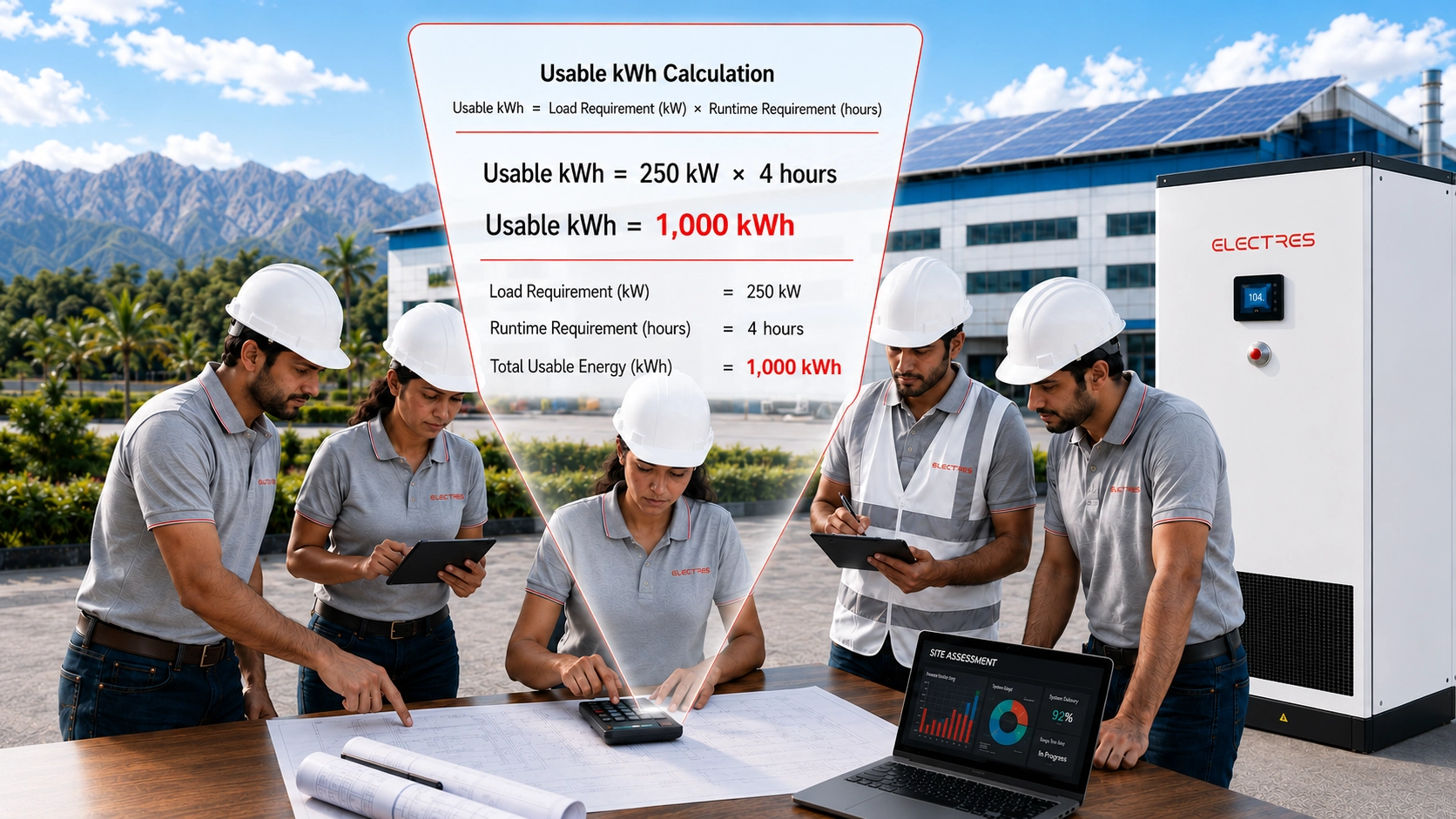
Similarly, if a facility needs to support a 250 kW critical load for four hours during an outage, the required usable energy would be:
Usable kWh = Load Requirement (kW) × Runtime Requirement (hours).
Usable kWh = 250 kW × 4 hours = 1,000 kWh.
This means the battery must deliver 1,000 kWh of usable energy to the facility load.
However, converting this operational requirement into an actual installed battery specification requires three additional parameters that significantly affect the final system size.
Depth of Discharge (DoD) is the percentage of rated battery capacity that can be drawn without affecting battery life. LFP chemistry batteries typically operate at 80–95% DoD, while NMC chemistry batteries typically operate at 70–80% DoD. Sizing a system based on 100% of rated capacity can lead to routine over-discharge and faster degradation.
Round-Trip Efficiency (RTE) accounts for energy lost during the charge-discharge cycle. LFP systems typically achieve 88–94% RTE, while NMC systems typically achieve 88–92% RTE. This means that for every 100 kWh the facility requires, the battery must store more than 100 kWh to compensate for these losses.
C-rate defines the maximum power the battery can discharge relative to its capacity. For example, a 1,000 kWh battery at 0.5C can deliver up to 500 kW. If the facility’s peak power requirement exceeds the battery’s discharge capacity, the system will not respond effectively to demand spikes, even if sufficient energy is stored.
Step 1: Calculate Required Usable Energy
Usable kWh = Load Requirement (kW) × Runtime Requirement (hours).
This is the energy the battery must actually deliver to facility loads.
Step 2: Calculate Required Installed Battery Capacity
Installed kWh = Usable kWh ÷ (DoD × RTE)
This is the rated battery capacity required to deliver the usable energy after accounting for discharge limits and efficiency losses.
For example, if the facility requires 1,000 kWh of usable energy, with 90% DoD and 90% RTE, the installed capacity would be:
Installed kWh = 1,000 ÷ (0.90 × 0.90)
Installed kWh = 1,000 ÷ 0.81
Installed kWh = 1,235 kWh
So, the facility would require approximately 1,235 kWh of installed battery capacity to reliably deliver 1,000 kWh of usable energy.
Step 3: Verify Peak Power Capability
Maximum Discharge kW = Installed kWh × C-rate
This confirms whether the battery can deliver the required power during peak demand.
For example, if the installed battery capacity is 1,235 kWh and the system has a 0.5C discharge rate, the maximum discharge power would be:
Maximum Discharge kW = 1,235 × 0.5 = 617.5 kW
If the facility requires 800 kW of peak support, this system would not be sufficient from a power-output perspective. In that case, the battery capacity, inverter rating, or system configuration must be adjusted to meet the required discharge power.
Actual BESS sizing should therefore consider both energy and power requirements, as well as DoD, RTE, C-rate, reserve margin, site conditions, temperature impact, and future operational growth.
Factors That Influence BESS Capacity in Industrial Facilities
Two facilities with similar electricity bills may still require completely different battery sizes. The difference usually comes from how electricity behaves during operations rather than how much electricity is consumed overall.
One of the most important factors is the facility load profile. Some facilities operate with stable, continuous demand, while others experience sudden spikes during shift startup, heavy equipment operation, or seasonal cooling demand.
Interval-level load analysis helps identify:
- When demand spikes occur.
- How long do they last?
- Which equipment contributes most heavily to peaks.
- Whether demand behavior changes during different operating periods.
Without this level of analysis, battery sizing becomes largely based on assumptions.
The operational objective also significantly influences system size. A battery installed primarily for peak shaving may prioritize high kW response at the expense of runtime. A backup-focused system may require larger kWh capacity to support operations for several hours during outages.
Solar integration introduces another important sizing factor. Facilities using rooftop solar often install batteries to store excess daytime generation for evening operations or to improve solar self-consumption. In these cases, battery sizing depends not only on facility demand but also on solar generation behavior throughout the day.
Backup prioritization is equally important. Many facilities do not require full-plant backup during outages. Instead, they need support only for critical systems such as process controls, IT infrastructure, cooling systems, and essential production equipment. Prioritizing only critical loads can significantly reduce battery size and project costs.
Future expansion planning should also be considered during sizing. Battery systems are long-term infrastructure investments, and facilities expecting production growth, additional machinery, or increased operating hours should account for future changes in demand when planning the system.
Why BESS Sizing Depends on Operational Application
Different operational objectives require different battery sizing strategies. The same battery configuration cannot optimise every application equally well.
Peak shaving systems are typically designed to reduce short-duration demand spikes. These applications prioritize fast response capability and high kW discharge. In many facilities, the battery may discharge for only 15 to 30 minutes during peak-demand conditions, but the system must respond instantly to be effective.
Backup power applications focus more heavily on runtime duration. Facilities such as hospitals, data centers, and critical manufacturing environments may require several hours of uninterrupted operation during outages. In these situations, larger kWh capacity becomes more important than short-duration discharge capability.
Solar-integrated systems often require a more balanced approach because the battery may perform multiple functions simultaneously. The system may store excess solar energy during the day, support evening demand, reduce grid dependence, and assist with demand charge management.
Comparing BESS Priorities Across Applications
| Application | Main Focus | Typical Requirement |
|---|---|---|
| Peak shaving | High kW response | Short-duration discharge |
| Backup power | High kWh duration | Extended runtime support |
| Solar shifting | Balanced kW and kWh | Energy storage and load support |
| Demand reduction | Fast system response | Peak demand control |
The application objective ultimately determines how the battery should be optimised for performance.
BESS Sizing Mistakes That Reduce BESS Performance and Efficiency
Many BESS projects fail to achieve expected savings because system sizing decisions are made without a full understanding of actual facility operations. Incomplete demand analysis, improper backup planning, and unclear system objectives often lead to oversized or undersized battery configurations that affect both performance and long-term project value.
- Using Only Monthly Electricity Bills: Relying only on monthly consumption data does not reveal short-duration peaks, startup surges, or overlapping load conditions that significantly influence battery sizing requirements.
- Ignoring Interval Demand Analysis: Without analyzing interval-level demand patterns, facilities may overlook short-duration spikes that heavily impact demand charges and inverter sizing.
- Oversizing Backup Requirements: Attempting to support every load in the facility often unnecessarily increases project costs. Prioritizing only critical operations usually delivers better financial and operational balance.
- Ignoring Future Facility Expansion: Production growth, process additions, and future equipment expansion should be considered during sizing. Otherwise, the system may become undersized much earlier than expected.
- Unclear System Objectives: BESS sizing becomes inefficient when facilities do not clearly define whether the primary goal is backup support, peak shaving, energy optimisation, or operational continuity.
Common BESS Sizing Mistakes
Frequent sizing errors can reduce battery performance, savings potential, and long-term system efficiency.
- Using only monthly electricity bills.
- Ignoring interval demand analysis.
- Oversizing unnecessary backup loads.
- Ignoring future operational growth.
- Not defining clear system objectives.
BESS Sizing Process for Industrial Energy Systems
Professional BESS sizing is based on detailed operational analysis to ensure the system aligns with the facility’s actual energy behavior and performance requirements.
- Engineers evaluate interval demand patterns, peak timing, operating schedules, and seasonal load variation to understand how electricity is consumed across facility operations.
- The operational objective is clearly defined before sizing begins, whether the system is intended for peak shaving, backup continuity, solar optimisation, load shifting, or demand charge reduction.
- Critical operations are identified to determine which loads require uninterrupted power support and which systems can remain disconnected during outages.
- Operational simulations are performed to estimate demand-charge savings, backup runtime capability, solar utilization improvements, and system response under high-load conditions.
- Future operational growth, production expansion, and changing energy requirements are also considered during the sizing process to improve long-term system performance.
This structured approach helps create a more accurate and reliable BESS configuration based on real operating conditions rather than rough estimation.
Electres BESS Solutions for Reliable Energy Management
Electres BESS sizing is designed around actual facility operating conditions rather than generic battery assumptions. The system evaluates energy behavior, operational priorities, and long-term performance requirements before recommending a suitable configuration.
- Peak Demand Management: Supports demand-reduction strategies by analyzing actual facility load patterns and peak usage behavior.
- Backup Continuity: Identifies critical operations that require uninterrupted power support during outages or grid instability.
- Solar Utilization: Evaluates opportunities to improve solar energy consumption, storage efficiency, and self-utilization performance.
- Load Shifting Capability: Helps shift energy use away from peak periods, improving operational efficiency and controlling electricity costs.
- Operational Stability: Supports stable facility performance during fluctuating demand conditions and changing load requirements.
- Long-Term Scalability: Considers future expansion plans, operational growth, and evolving energy requirements during system sizing.
This approach helps create a BESS configuration that more closely aligns with real facility operations, performance expectations, and long-term energy goals.
Conclusion
Choosing the right BESS size is not simply about installing more battery capacity. The system must align with how the facility actually consumes electricity, experiences demand spikes, prioritizes critical operations, and plans future growth.
A properly sized BESS improves operational reliability, strengthens backup continuity, reduces demand charges, and increases long-term energy efficiency.
The most important step is understanding both:
- How much power does the facility require instantly?
- How long must that support continue?
When these factors are analyzed correctly, the battery system becomes more reliable, financially effective, and operationally valuable over the long term.
FAQs
How do I know what size BESS my facility needs?
What is the difference between kW and kWh in BESS sizing?
Can a smaller BESS still reduce demand charges?
Why is load profile analysis important for BESS sizing?
Should a BESS support the entire facility or only critical loads?
How does solar integration affect BESS sizing?
What happens if a BESS is oversized or undersized?
Can BESS sizing account for future facility expansion?