Diesel Generator vs BESS: The Unmatched Comparison
Comparing DG and BESS only on upfront can be misleading. What matters more is how each system performs during actual plant outages, especially under low-load conditions where DG operating costs rise sharply. This article compares both across practical factors such as cost, switchover time, maintenance, compliance, and reliability. It also explains why a BESS-first hybrid setup can provide a more efficient and balanced backup power strategy for industrial operations.
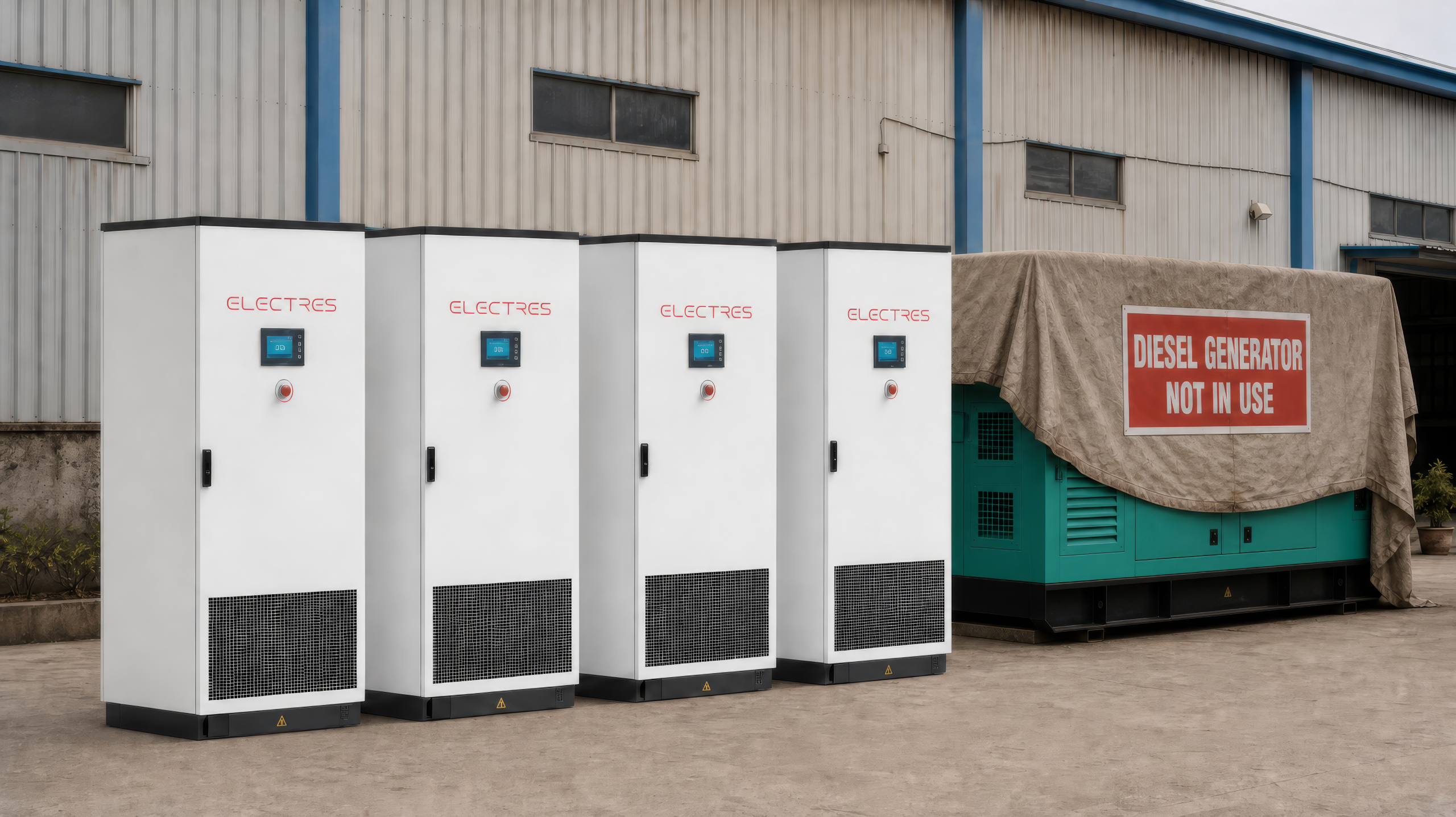
How DG and BESS Are Compared Under Real Plant Conditions
A clear comparison between DG and BESS only works when both are evaluated under the same operating conditions within industrial facilities. Backup systems perform differently depending on how frequently they are used and the load at which they operate. Without defining this context, the comparison can be misleading and difficult to apply to real plant operations.
The DG in This Comparison
This comparison focuses on diesel generators commonly used in industrial facilities that operate during regular grid outages for extended periods each day. In many cases, these systems run at partial load rather than full capacity. This reflects a typical operating pattern seen across industrial facilities. These generators are not used occasionally. They function as a regular source of backup power, often running every working day. At lower load levels, fuel efficiency drops and operating costs increase, which makes it important to evaluate their performance in this exact scenario.
The BESS in This Comparison
The BESS considered here is a grid-charged LFP-based system designed according to the plant’s actual load and outage duration. It includes key components such as BMS, PCS, EMS, thermal management, and containerised housing. System sizing is based on a site assessment, ensuring the comparison reflects practical, real-world conditions within industrial operations.
Full Cost Comparison Across Six Key Factors
A clear comparison between DG and BESS becomes more useful when it is broken down into the factors that directly affect plant operations. Cost is important, but it is not the only consideration. Switchover time, maintenance needs, compliance requirements, and noise levels all influence how a backup system performs in a real industrial environment.
The table below brings these elements together to provide a side-by-side view based on typical operating conditions. It reflects how diesel generators perform at partial load in daily-use scenarios and compares that with a BESS designed for the same application.
| Dimension | DG at Typical C&I Load | Electres BESS at Typical C&I Load |
|---|---|---|
| Switchover Time | 10 to 30 seconds | 200 ms |
| Monthly Fuel Cost | High cost | No fuel cost |
| Maintenance Frequency | Frequent servicing, affected by low load | Annual or quarterly inspection |
| Compliance Risk | Subject to CPCB IV+ and GRAP like bans | No emissions |
| Noise | High noise levels | Low noise levels |
Among these factors, the cost of power has the most direct impact on monthly operating expenses. Diesel-based generation tends to be expensive and variable, especially at partial loads, while BESS provides a more stable and predictable cost structure. Over time, this difference can significantly influence overall energy expenses in industrial operations.
Actual savings will vary based on the plant’s load profile, outage patterns, and operating conditions.
Four Operational Factors the Cost Table Does Not Capture
Cost is often the first factor considered, but it is not the only one that affects the final decision. In daily plant operations, reliability, compliance, installation requirements, and performance during different outage conditions all play an important role. These factors directly influence production continuity, operating risk, and long-term system performance.
1. Production Reliability
| DG Cold Start | Electres BESS | |
|---|---|---|
| Time to Stable Power | 10–30 seconds | 200 ms |
| Process | ATS detects loss → engine cranks → warms up → voltage stabilises → load transferred. During this gap: CNC machines trip, PLCs lose state, production lines stop. Every single outage. | PCS monitors grid voltage continuously. Upon loss, it switches to island mode within 200 ms. CNC machines, PLCs, and VFDs continue operating with minimal disruption. |
DG systems follow a start-up sequence that creates a delay before power is restored. During this time, machines shut down and production is interrupted. Each outage adds to lost production time, especially in facilities with frequent power cuts.
2. Regulatory and Compliance Risk
Regulatory requirements around diesel generators are becoming stricter, particularly in industrial and urban operating environments. Emission norms and air quality regulations are increasing the compliance burden on DG-based backup systems.
BESS operates without emissions, which removes this uncertainty and provides greater operational stability as regulations continue to evolve.
3. Space and Installation Requirements
DG installations require multiple supporting elements, including fuel storage, exhaust routing, ventilation, and safety clearances. These requirements increase the overall space needed and add to installation complexity.
In comparison, BESS systems are modular and more compact. They are typically delivered as pre-integrated units that require only a prepared foundation and electrical connection. This simplifies deployment and reduces disruption during installation, especially in facilities where space is limited.
4. Performance During Extended Outages
BESS systems are designed based on the facility’s outage pattern and expected duration. They perform efficiently within their defined capacity, which can be increased based on assessment and future requirements. The system is intelligent and continuously analyzes usage patterns to optimize performance accordingly. When an outage extends beyond that capacity, the system can shift to DG support or solar (if available), helping reduce costs at a much more efficient level.
In this setup, the DG does not run continuously at low load. Instead, it starts when required and operates closer to its optimal load range. This improves fuel efficiency and reduces wear over time.
How BESS and DG Work Together During Extended Outages
One of the most common concerns in industrial operations is what happens during longer outages that go beyond typical backup durations. In many cases, the assumption is that diesel generators should take over completely. However, a more practical approach is a BESS-first hybrid setup, where the battery system manages regular outages, and the DG supports only when required.
Bess Handles Every Outage: The Dg Is Its Backup, Not the Other Way Around
In this setup, BESS handles each outage automatically. The system is designed based on the facility’s load and outage pattern, so it can cover most day-to-day interruptions. When the battery reaches a defined level, the system starts the DG without manual intervention. At this point, the DG runs closer to its optimal load range, instead of operating continuously at lower load levels. This change in how the DG operates has a direct impact. Fuel consumption decreases because the generator is no longer running inefficiently. Issues like wet stacking are avoided, and the equipment experiences less wear since it runs only when needed and under better conditions. Over time, this also improves maintenance cycles and overall reliability of the system.
Four Questions to Help You Decide Between DG and BESS
Choosing between DG and BESS depends on how your facility operates during outages. Instead of looking at a single factor, it helps to break the decision into a few practical questions. Each question below connects to a clear outcome based on your facility’s situation.
In the sections below, a “Yes” means the issue is already affecting your operations and may strengthen the case for evaluating alternatives to DG-only backup, including BESS where relevant. A “No” means the issue may be less severe today, but it can still be useful to review whether your current backup setup is the right long-term fit. The guidance under each answer explains what that response suggests and what to consider next based on your facility’s situation.
Q1. Does Your Plant Experience Grid Outages That Affect Production or Equipment?
| Yes | No |
|---|---|
| Frequent outages often lead to repeated costs through fuel use, equipment stress, and production interruptions. A more stable backup system like BESS can help reduce these ongoing impacts. | Even with fewer outages, reviewing your backup approach can still be useful. Faster transitions and reduced diesel dependency may improve overall efficiency over time. |
Q2. Does Your Plant Have Equipment That Trips, Resets, or Loses State During a Power Interruption?
| Yes | No |
|---|---|
| Many industrial systems are sensitive to even short power gaps. When interruptions occur, machines stop and require time to restart, which affects productivity. A system like BESS, that ensures seamless transition can help maintain continuity. | Even if your equipment is less sensitive, the operating cost of running a DG at low load remains high. Exploring alternatives can still lead to better cost control. |
Q3. Is Your Plant Looking to Reduce or Eliminate Production Losses from Power Interruptions?
| Yes | No |
|---|---|
| Regulatory requirements can limit when and how DGs are used. A system like BESS without emissions removes this uncertainty and allows more consistent operation without interruptions. | Even if restrictions are not immediate, compliance requirements are becoming stricter over time. Evaluating alternatives early can help you stay prepared. |
Q4. Is your plant looking to reduce or eliminate production losses from power interruptions?
| Yes | No |
|---|---|
| Reducing downtime starts with understanding your load pattern and outage history. A detailed assessment can help estimate the right BESS system size and the potential improvement in operations. | Even without direct production loss today, it is worth considering future needs. Changes in regulations and energy costs can make early evaluation beneficial. |
Looking at these factors together helps you move from assumption to clarity. A site-specific assessment can turn these insights into practical insights and a more confident decision.
What the Numbers Tell You Before Making a Decision
Before making a financial case for any change in your backup power setup, it helps to look at the cost aspects clearly. Many decisions are delayed not because the solution is unclear, but because the actual cost and savings are not fully understood. The three points below can help you build a simple and realistic view before taking this discussion forward.
Number 1. What You Are Currently Spending on Backup Power
Start by reviewing your diesel expenses over recent operating months. Add the total amount spent and divide it by the estimated units (kWh) generated. You can calculate this using your DG hour meter readings and the average kW output at your usual load. In many cases, diesel-based power comes at a significantly higher cost per unit, especially under partial load conditions. Many teams find that the actual cost per unit is higher than expected once they calculate it clearly. This gives you a reliable starting point.
Number 2. What the Savings Looks Like
The cost of stored energy depends on system design, usage pattern, and site conditions. When compared with your DG cost per unit, this difference shows the potential savings. In addition, savings may also come from reduced diesel use, lower demand charges, and better use of time-based tariffs. The actual value depends on your facility’s usage pattern, tariff, and outage frequency.
Number 3. What the Savings Looks Like
Payback depends on how often your facility relies on backup power and the cost difference you observe. Using the same approach, you can estimate how quickly the investment may recover. Facilities with higher DG usage or frequent outages typically see faster payback, while others may take longer depending on their conditions.
Five Questions Every Stakeholders Should Ask Before Committing
Before making a decision, it is natural to have a few concerns about how a new system will perform in real conditions. These questions often come up during internal discussions, especially when comparing reliability, safety, and long-term value. Addressing them clearly helps in moving forward with more confidence.
| Objection | Honest Answer |
|---|---|
| I'd rather upgrade my DG to CPCB IV+. | Upgrading to meet stricter emission standards improves emissions, but it does not change how the DG performs at partial load. The cost per unit under these conditions remains in a similar range. This means compliance improves, but operating cost stays largely unchanged. |
| Can BESS handle our peak demand startup load? | The system is designed based on your facility’s actual load, including the startup requirements of heavy equipment. This is checked during the site assessment, so it is based on real data rather than estimates. It is always a good idea to ask for these specifications in writing before finalising. |
| What about battery fires? I've read about them. | Most industrial BESS use LFP chemistry, which is known for its stable performance. It behaves differently from other battery types used in consumer devices. In addition, systems include monitoring, temperature control, and protective design features to maintain safety. |
| What happens after 10 years? What do I do with old batteries? | Batteries do not stop working suddenly after their primary life. They usually retain a large part of their capacity and can continue to be used or replaced in parts. The system is designed in a modular way, so replacement does not mean changing everything at once. |
Conclusion
For industrial facilities that rely on DG systems at low load during frequent outages, the difference in operating cost compared to BESS is both clear and consistent. Along with lower costs, BESS also offers more stable power, reduced maintenance effort, and fewer compliance concerns over time.
For situations where outages last longer than expected, a combined setup can provide a better balance. In this approach, BESS handles regular interruptions, while the DG supports extended use when required. This helps maintain continuity without compromising efficiency.
Over time, the focus shifts from choosing one system over another to finding the right combination based on how your plant operates. If you want to understand how this applies to your facility, a detailed assessment can help estimate savings and define a suitable system design.
FAQs
Is a Bess Always Cheaper Than a DG for Backup Power?
Does BESS Work in India’s High Temperatures, Up To 45–50°C?
What Is the CPCB IV+ , And How Does It Affect Existing DG Sets?
How Does BESS Handle Motors with High Startup Load?
What Is the Difference Between LFP and NMC Batteries, and Why Does It Matter?